“Culinary Splash Effect” Energizes Food Photography
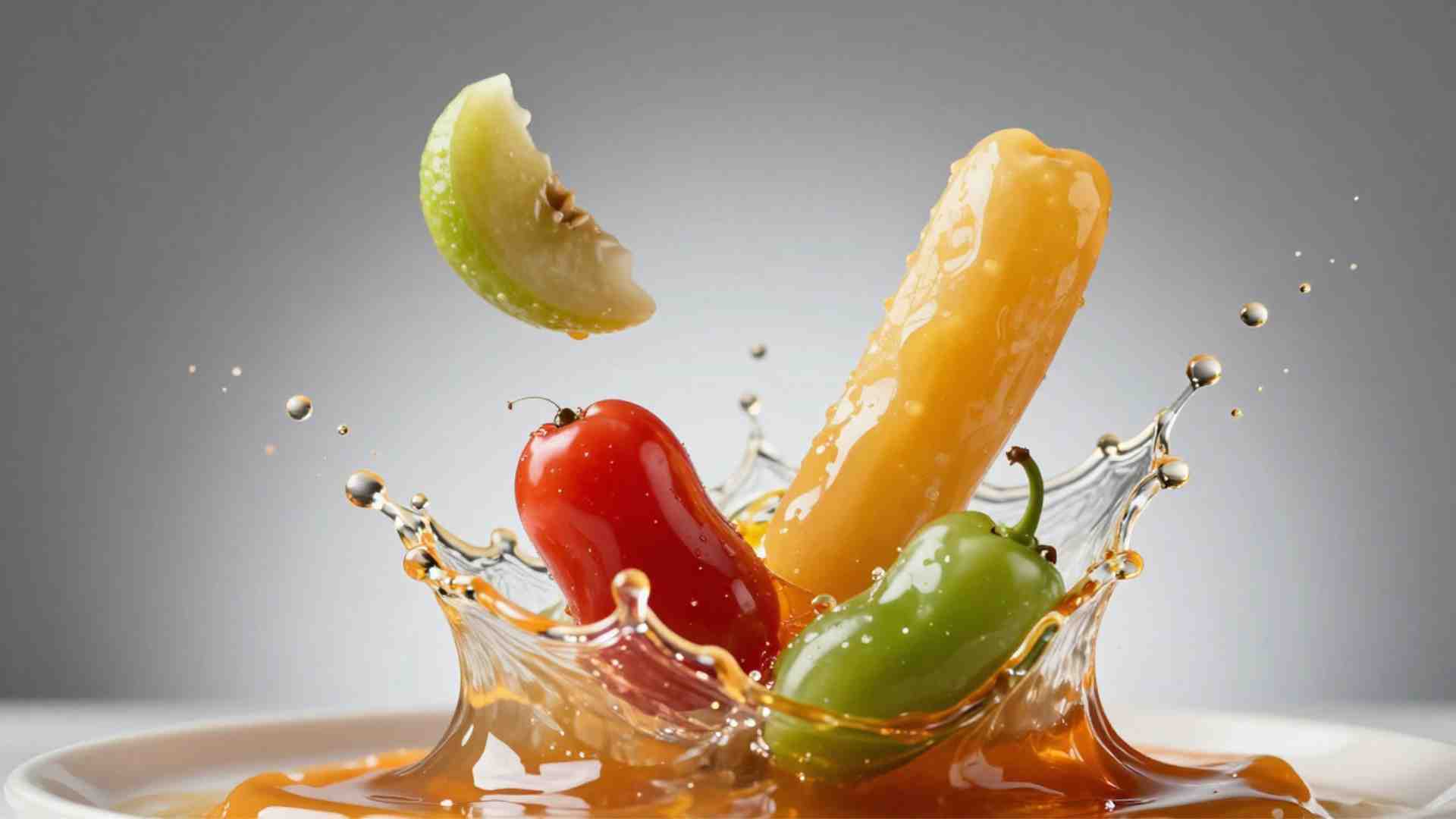
The culinary splash effect stands as a cornerstone technique in modern food photography, transforming static images into vibrant displays of motion and freshness. This method involves capturing liquids, sauces, or ingredients in mid-air or upon impact, using high-speed photography to freeze the action.
The result is a visually compelling image that evokes appetite and energy, making it indispensable for advertising, editorial, and creative food shoots. By emphasizing the natural dynamics of food elements—like a cascade of milk enveloping a strawberry or juice erupting from citrus—the splash effect elevates ordinary compositions into professional masterpieces.
This article delves into its mechanics, applications, equipment, and execution, providing a comprehensive guide for photographers aiming to incorporate this technique.
Definition and Core Principles of the Culinary Splash Effect
At its essence, the culinary splash effect refers to the visual phenomenon where liquids or semi-liquids in food contexts—such as beverages, soups, sauces, or oils—are captured in dynamic states. These include droplets scattering upon impact, waves forming from pours, or rings expanding in a liquid surface. The term “culinary splash effect” encapsulates how these elements, when unconstrained, form intricate shapes that the naked eye cannot fully perceive due to their rapid occurrence.
Photographers achieve this by employing shutter speeds of 1/1000 second or faster, often combined with high-speed flashes or strobes to halt motion without blur. The effect highlights freshness: splashing water or juice inherently conveys vitality and excitement, making food appear more inviting. Gastrophysics research supports this, indicating that depicting food in motion heightens viewer interest and stimulates appetite, as it suggests immediacy and consumption.
Unlike static food styling, the splash effect introduces action, turning a simple glass of juice into a scene of chaotic energy with dispersed drops and ricochets. It’s not limited to one style; splashes can range from symmetrical and controlled—achieved by releasing liquid straight down—to messy and organic, like flinging wine from a glass. This versatility allows it to adapt to various food types, from berries plunging into yogurt to sauces drizzling over dishes.
Origins and Evolution in Food Photography
The high-speed splash effect owes much to pioneers like Harold Edgerton, an MIT professor and inventor who revolutionized photography through stroboscopic techniques. Edgerton’s work with strobes, replacing outdated flash bulbs, enabled the capture of ultrafast phenomena, including liquid dynamics in culinary contexts. His iconic images, such as a milk drop forming a coronet, demonstrated the elegance of frozen motion and influenced food photographers to explore similar visuals.
This innovation shifted food photography from static portrayals to dynamic narratives. Early adopters recognized that revealing unseen details—like the precise shapes of droplets—added intrigue. Over time, the technique evolved with digital advancements, making it accessible beyond specialized labs. Today, it’s a staple in commercial work, where teams collaborate to craft perfect splashes that align with brand aesthetics, emphasizing how the effect has democratized high-energy food imagery.
Reasons to Incorporate the Culinary Splash Effect
The culinary splash effect serves multiple purposes in food photography, primarily enhancing visual appeal and marketability. First, it conveys freshness: a splash of juice against fruits implies peak ripeness and health, ideal for promoting products like cold-pressed juices. This aligns with consumer preferences for vibrant, natural imagery that suggests quality.
Second, it boosts engagement. Human perception is drawn to motion; gastrophysics shows that dynamic food presentations increase appetite by mimicking real-life interactions, such as squeezing a lemon over a salad. In advertising, this translates to higher viewer retention and desire.
Third, it adds variety. Not all splashes are identical—messy versions suit rustic themes, while symmetrical ones fit scientific or premium branding. This flexibility extends to any photography style, from macro close-ups to broader compositions, making it eye-catching even in non-commercial work.
Finally, it captures the imperceptible. Events unfolding in fractions of a second, like a berry’s immersion in milk, become visible, intriguing audiences similar to time-lapse or macro techniques. Commercial splashes, far from accidental, result from meticulous planning, ensuring they entice without distraction.
Variations and Styles of Splash Effects
Splash effects vary based on execution, offering photographers creative latitude. A basic type is the ring splash, created by dropping liquid vertically into another liquid or hard surface, forming concentric waves. This is precise and often used for symmetrical compositions.
Wave splashes emerge from controlled releases, like unfurling liquid from a glass, producing arcs with trailing droplets. These are ideal for beverages, adding elegance.
Chaotic splashes occur from impacts, such as shooting juice against solids, resulting in dispersed drops and rebounds. These convey energy and are perfect for fruit or vegetable shots.
Alternatives like the pour effect simulate motion without full splashes, adding life to static dishes. Viscosity plays a role: thicker liquids (e.g., sauces) create slower, more defined shapes, while thinner ones (e.g., water) yield finer droplets.
To illustrate variations, consider this table summarizing common splash types:
| Splash Type | Description | Best For | Example |
|---|---|---|---|
| Ring Splash | Liquid dropped straight down, forming rings on impact | Symmetrical, scientific shots | Milk into a bowl |
| Wave Splash | Controlled fling or pour, creating arcs | Elegant beverage images | Wine from a glass |
| Chaotic Splash | High-impact collision with ricochets | Energetic, fresh produce | Juice against oranges |
| Pour Effect | Steady stream adding motion | Static dishes needing vitality | Sauce over pasta |
This diversity ensures the effect adapts to project needs, from advertising to artistic expression.
Techniques for Achieving Perfect Splash Shots
Mastering the culinary splash effect requires precision in timing and setup. The moment of capture is critical—a 1/60 second delay can disperse the splash or obscure key elements. High shutter speeds (1/1000 to 1/8000 second) freeze action, but ambient light often insufficiently supports these without blur.
Strobes are essential, delivering intense light in microseconds, effectively acting as the exposure duration. Pairing with burst mode allows continuous shooting, capturing shape variations over split seconds.
Styling influences outcomes: heavier objects like berries generate larger splashes, while additives adjust liquid viscosity for desired forms. Messy processes yield rewarding results, but cleanup is key.
For originality, experiment with unconventional liquids—oils for glossy sheens or colored sauces for vibrancy. Contexts matter: splashing against complementary surfaces enhances narrative.
A flowchart outlines the process:
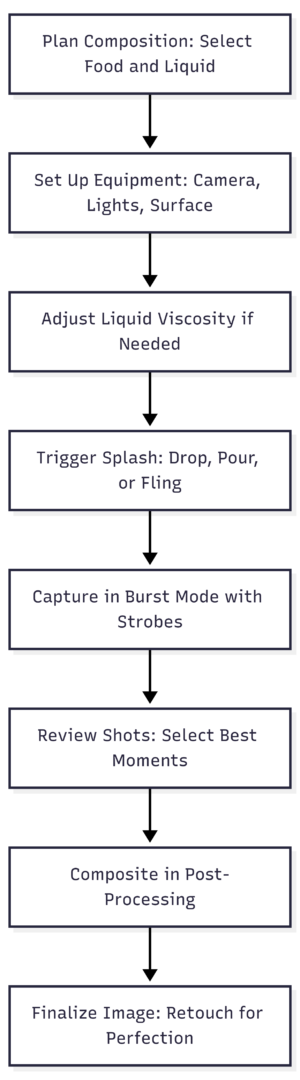
This sequence ensures systematic execution, from preparation to polish.
Essential Equipment for Culinary Splash Photography
Equipment selection is pivotal for sharp, blur-free splashes. Digital SLRs excel over traditional film, offering shutter speeds up to 1/4000 second and burst modes. Strobes with high sync and recycle speeds are crucial, as they handle rapid firing without ambient interference.
Considerations include flash duration (T.1 rating), which shortens at lower power for freezing motion. ISO adjustments compensate for reduced output, maintaining depth of field without noise.
A sample setup includes:
- Camera: Sony A7 III – 24.2MP full-frame sensor, 10FPS burst, ISO 50-204800, 4K video capability. Current price: approximately $1,800 (varies by retailer).
- Lens: Sony Zeiss 90mm f/2.8 Macro Lens – FE mount, 1:1 magnification, Optical SteadyShot stabilization, minimum focus 0.28m, 9-blade aperture for smooth bokeh. Current price: approximately $1,100.
- Softbox: Pixapro 120cm Octagonal Softbox – Heat-resistant fabric, durable rods, interchangeable speedring for compatibility, double diffusion for soft light. Current price: approximately $80.
- Flash: Pixapro Pika 200 TTL – 200Ws power, 8-stop range (1/1 to 1/128), TTL/manual modes, 5600K color temperature, recycle time 0.01-2.1 seconds, flash duration up to 1/8474 second at low power. Current price: approximately $300.
- Scrim: 5×7 foot Photography Scrim – Collapsible aluminum frame, diffusion fabric, reversible white/black panel for light control. Current price: approximately $90.
- Surface: Plexiglass Sheet – Clear acrylic, 1/8″ thick (e.g., 48×96″ for large setups), durable and easy to clean for standing glasses or capturing reflections. Current price: approximately $150 (depending on size).
Here’s a table detailing equipment specifications and prices:
| Equipment | Key Specifications | Approximate Price (USD) |
|---|---|---|
| Sony A7 III Camera | 24.2MP sensor, 10FPS, ISO 50-204800, full-frame | $1,800 |
| Sony Zeiss 90mm f/2.8 Macro Lens | 90mm focal length, f/2.8 aperture, 1:1 macro, OSS | $1,100 |
| Pixapro 120cm Octagonal Softbox | 120cm diameter, double diffusion, heat-resistant | $80 |
| Pixapro Pika 200 TTL Flash | 200Ws, TTL compatible, 1/8474s duration at low power | $300 |
| 5×7 Foot Scrim | Aluminum frame, diffusion/reversible panel | $90 |
| Plexiglass Sheet (48×96″, 1/8″ thick) | Clear cast acrylic, UV resistant | $150 |
Prices are current estimates and may vary; check retailers for updates. This gear enables professional results, with the flash’s low-power mode ensuring fast durations for motion freeze.
Lighting Setup for Optimal Results
Lighting defines splash photography success. Strobes outperform continuous lights by providing brief, powerful bursts that freeze action. Position a single source behind the subject, diffused through a softbox and scrim, to illuminate droplets without reflections.
Flash duration matters: T.1 measures full output cycle, unlike misleading T.5 (to 50% power). Lower power yields shorter durations (e.g., 1/8474 second), ideal for splashes, with faster recycling for bursts.
Sync speed caps shutter at 1/250 second typically; exceeding causes black bands. Avoid ambient light to prevent blur—use maximum sync in dim rooms. For creative blur, employ rear-curtain sync, freezing droplets ahead with trailing tails.
ISO boosts exposure at low flash power, but cap at noise-free levels (e.g., ISO 800 on modern cameras). This setup captures intricate details, like droplet textures, enhancing the effect’s appeal.
Capturing and Post-Processing the Splash
Execution demands speed: droplets move too fast for manual timing, so use burst mode on a tripod for consistent framing. Lower flash power enables rapid recycling, yielding sequences to select from.
Post-processing composites multiple shots—layer best splashes via masks in software like Photoshop. Remove distractions: erase errant droplets, shadows, or imperfections for a polished commercial look.
Experienced retouchers specialize in liquid motion, ensuring coherence. Additives like thickeners control viscosity pre-shoot, while robots in advanced studios precise triggers.
Tips for Innovation and Common Pitfalls
To stand out, redefine the effect: pair unusual liquids (e.g., vibrant oils) with contexts (e.g., splashing against herbs). Experiment like Edgerton—trial yields mastery.
Avoid pitfalls: over-dispersion from delayed shutters, blur from ambient light, or inconsistent viscosity. Studio teams, including stylists, ensure precision.
The effect’s messiness requires protective measures, but rewards justify it. Integrate with trends like macro for amplified impact.
Conclusion: Elevating Food Imagery with Splash Dynamics
The culinary splash effect energizes food photography by infusing motion, freshness, and intrigue. From basic techniques to advanced setups, it offers tools for captivating images that drive appetite and engagement. With proper equipment and practice, photographers can master this method, producing professional results that resonate in advertising and beyond. Embrace experimentation to redefine boundaries, turning everyday food into dynamic art.
Please share this “Culinary Splash Effect” Energizes Food Photography with your friends and do a comment below about your feedback.
We will meet you on next article.
Until you can read, 5 Steps to Discover Your Unique Food Photography Style