10 Wacky Food Photography Terms And What They Mean
Food photography has its own language. Walk onto a professional shoot without knowing it, and you’ll feel completely lost. Terms like “hero food,” “toasties,” “bacon ribbons,” and “the martini shot” sound bizarre until someone explains them—at which point they make perfect, logical sense. Add in the technical camera vocabulary—aperture, bokeh, ISO, depth of field—and you have a full dialect that separates beginners from pros.
This guide breaks down 10 wacky industry terms and layers in the essential technical terms every food photographer needs. Whether you’re shooting for a food blog or working on commercial campaigns, fluency in this language will speed up your workflow and your learning curve.
Why Food Photography Has Its Own Language
Professional food photography sets run like film productions. There are stylists, assistants, art directors, retouchers, and photographers all moving fast and communicating constantly. Shorthand exists because precision matters and time costs money. Saying “mark the plate” takes one second. Explaining what that means from scratch takes thirty. The jargon isn’t gatekeeping—it’s efficiency.
That said, the terms can be intimidating when you first encounter them. The goal here is to demystify them entirely.
The 10 Wacky Food Photography Terms
1. Stand-In Food
Stand-in food is the dish you throw on a plate before the real cooking is done. It’s used to rough in your camera angle, adjust lighting, position props, and dial in your composition—all without touching the food that actually matters.
This is critical when shooting food that wilts, melts, or degrades quickly. You can’t spend twenty minutes adjusting a softbox while a perfectly plated salad turns brown. The stand-in takes the abuse while you set up the shot. When everything is locked in, the hero food comes out.
The term comes directly from the film world, where stand-in actors fill a star’s place while the crew sets up lighting and camera positions before filming begins.
2. Hero Food
Hero food is the final, perfectly styled dish photographed for the actual deliverable—the client’s campaign, the cookbook spread, the blog post thumbnail. Every decision made during the stand-in phase was made to serve the hero shot.
On commercial shoots, the hero shot gets done first. Variations come after, only if schedule permits. In the industry, the hero dish is also called the beauty dish or beauty shot. The hero food must look its absolute best, which is why it’s never used for setup and never rushed.
3. Mark the Plate
When a plate is removed from set—whether for touch-ups in the kitchen or a quick styling adjustment—it needs to return to the exact same position. Marking the plate means using wood blocks or other markers to record precisely where on the surface the dish was sitting before it was moved.
This sounds minor. It is not. Without marked positions, bringing a plate back to set means reshooting several frames to re-find your original composition, which wastes time and breaks momentum. It’s one of the first professional habits that separates experienced stylists from beginners.
4. Spritz It
“Spritz it” is the instruction to keep food looking fresh on set using a fine spray of water or a brush of oil. As food sits under hot lights, it dries out, loses gloss, and stops looking appetizing. A quick spritz of water restores moisture on vegetables, bread, and desserts. A brush of oil adds sheen to proteins and keeps them looking juicy.
For animal proteins especially—steak, chicken, fish—the instruction sometimes escalates to “hose it down” because meat absorbs moisture so quickly under studio lighting. The goal is always to make the food look freshly prepared, even if it’s been sitting under a light for forty minutes.
5. Bacon Ribbons
Bacon ribbons are strips of bacon shaped into curves and folds rather than lying flat. Flat bacon looks dull in photographs. Bacon with undulation, height, and texture reads as rich, crispy, and indulgent—exactly what the image needs to convey.
To create them, you lay raw bacon strips over foil that has been shaped into ridges, or over rolled foil rods, then bake them that way. The bacon cooks into those curves and holds its shape. The result is dramatically more photogenic than anything cooked flat on a sheet pan.
6. The Crown and The Heel
In burger photography, the top bun is the crown and the bottom bun is the heel. These terms come directly from client-side language at fast food and fast casual brands and exist purely for communication speed on set.
Saying “get me a new crown” is faster and clearer than “can someone grab a replacement top bun.” Food stylists prep crowns and heels differently depending on their role in the final frame—the crown often gets more styling attention since it faces up and dominates the composition.
7. Food Rigging
Food doesn’t always cooperate. A stack of pancakes leans. Cherries roll. A burger patty slides. Food rigging is the practice of using hidden supports—toothpicks, skewers, pins, museum putty, cardboard inserts, even full internal armatures—to hold food in a position it wouldn’t naturally maintain.
The camera stays locked on a tripod so that rigging stays hidden behind the subject. Move the camera angle even slightly, and the skewer propping up a cherry stack comes into frame. Rigging is an art form in itself, and skilled food stylists carry an entire kit of tools dedicated to it.
8. Cheese Pulls and Cheese Walls
Pizza is notoriously difficult to photograph. One of the most requested and technically demanding shots is the cheese pull—the moment a slice is pulled from the whole pie and molten cheese stretches dramatically between them.
To get a successful cheese pull, stylists build a cheese wall: a hidden ridge of extra cheese placed along the pre-cut line beneath the top cheese layer. When the slice is pulled, the cheese wall provides the material needed for a long, photogenic stretch. Even with a cheese wall, the timing window is extremely short. Most commercial pizza shoots involve teams of five to seven food stylists working in coordination, and clients typically add significant retouching after the fact.
9. Toasties
Toasties are the small, browned, caramelized bits of cheese on a pizza—those dark bubbled patches that signal high heat and proper melting. On a hero pizza, toasties are applied individually by hand.
Stylists bake sheets of cheese on parchment specifically to harvest toasties. The resulting pieces are sorted by size and color depth, stored on damp paper towels, and then placed one by one onto the hero pie. A brush of oil and sometimes heat from a heat gun helps them blend seamlessly into the surrounding cheese. The retoucher may then augment or add toasties digitally in post-production.
10. The Martini Shot
The martini shot is the final shot of the day. On commercial sets, it’s a moment of celebration—the last item on the shot list is done, the shoot wrapped. The name comes from the tradition of celebrating with a drink after it’s complete.
On well-run commercial shoots with 8–12 hour days and multiple shots per day, reaching the martini shot means the schedule held, the food looked right, and everyone delivered. It’s earned, not given.
Essential Technical Terms for Food Photographers
Understanding the industry vocabulary is one half of the equation. The other half is understanding camera and light terminology. These terms govern every decision made before the shutter fires.
Camera Settings Reference Table
| Term | What It Controls | Recommended Range for Food |
|---|---|---|
| Aperture (f-stop) | Lens opening / depth of field | f/1.8–f/2.8 (shallow) / f/8–f/11 (full focus) |
| ISO | Sensor sensitivity to light | 100–400 (keep as low as possible) |
| Shutter Speed | Exposure duration | 1/100s–1/200s handheld; any speed on tripod |
| White Balance | Color temperature correction | Daylight, Cloudy, or Custom |
Depth of Field and Bokeh
Depth of field (DoF) describes how much of the image is in focus front-to-back. A shallow DoF isolates the hero food against a softly blurred background. A deep DoF keeps everything in frame sharp—used frequently in overhead (flat lay) compositions.
Bokeh is the quality of that blur in out-of-focus areas. Good bokeh is smooth and non-distracting. Poor bokeh is busy, ringed, or creates visual noise that competes with the subject. Bokeh quality depends on lens construction, which is why prime lenses (fixed focal length, like a 50mm or 100mm macro) are strongly preferred in food photography over kit zoom lenses.
The Exposure Triangle
Aperture, shutter speed, and ISO are interconnected. Changing one affects the others. This relationship is called the exposure triangle.

For food photography on a tripod (which is highly recommended), the typical approach is to set ISO as low as possible—100 or 200—then adjust aperture for desired depth of field, and use shutter speed to control final exposure. This produces the cleanest, sharpest image possible.
Light Quality: Hard vs. Soft
Hard light (direct sunlight, bare flash) creates sharp-edged, high-contrast shadows. In food photography, this is occasionally used for dramatic effect but more often avoided because it flattens texture and makes food look harsh.
Soft light (diffused window light, light through a scrim or softbox) creates gentle, graduated shadows that wrap around food and reveal texture naturally. Most food photography—especially natural light photography—relies on soft light as its foundation.
White Balance
White balance corrects for the color cast of different light sources. Tungsten light is warm and orange. Shade is cool and blue. If white balance is wrong, food that should look golden looks grey, and cream sauces look greenish. Most cameras handle this automatically with reasonable accuracy, but setting a custom white balance matched to your actual light source produces the most accurate, appetizing colors.
Noise
Noise is the grainy, speckled degradation that appears in images shot at high ISO. It’s most visible in shadow areas and looks like multicolored static. Some noise can be reduced in post-processing software like Lightroom or Capture One, but heavy noise reduction also softens fine detail. The best solution is to avoid it in camera by keeping ISO low and using a tripod when light is limited.
RAW vs. JPEG
| Format | Compression | Editability | File Size |
|---|---|---|---|
| JPEG | Lossy (data lost on save) | Limited | Small |
| RAW | Lossless (full sensor data) | Maximum flexibility | Large |
Shooting RAW preserves every bit of data the sensor captured. This means white balance, exposure, shadows, and highlights can all be recovered or adjusted significantly in editing without degrading image quality. JPEG files compress that data away at the moment of capture. For food photography where post-processing is part of the workflow, RAW is the professional standard.
Composition: Rule of Thirds and Negative Space
The rule of thirds divides the frame into a 3×3 grid. Placing the main subject at the intersections of those grid lines—rather than dead center—creates more dynamic, balanced compositions. Most cameras and smartphones can overlay this grid on the live view screen.
Negative space is intentional empty area around the food subject. It prevents the image from feeling cluttered, emphasizes the hero food, and leaves room for text when the image is used editorially or in advertising. Negative space is not wasted space—it’s compositional breathing room.
Putting It All Together
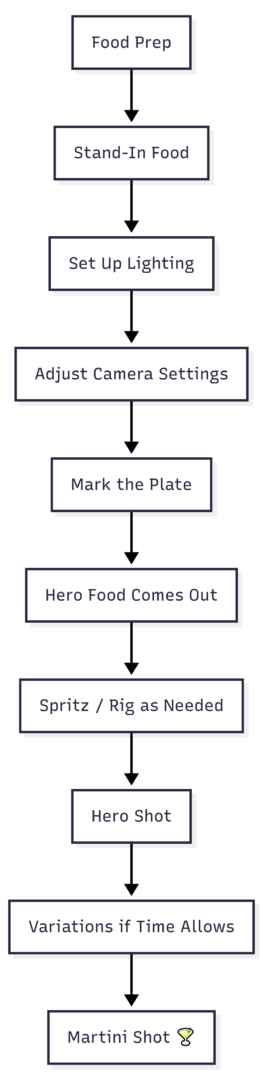
A professional food photography shoot follows a clear sequence. The technical terms govern the camera. The industry terms govern the set. Together, they form the operational language of the craft.
Understanding that the stand-in exists to protect the hero, that rigging keeps food in position, that cheese walls enable cheese pulls, and that the martini shot means everyone did their job—these things transform a confusing set into a logical, efficient environment.
And knowing that a low ISO keeps your image clean, that aperture controls how much of your dish is in focus, and that shooting RAW gives you maximum editing flexibility—these things make your technical decisions intentional rather than accidental.
The language seems wacky at first. Once it clicks, it becomes second nature. Start with these terms, and the rest of the vocabulary will follow.
Please share this 10 Wacky Food Photography Terms And What They Mean with your friends and do a comment below about your feedback.
We will meet you on next article.
Until you can read, How to Understand your camera’s histogram