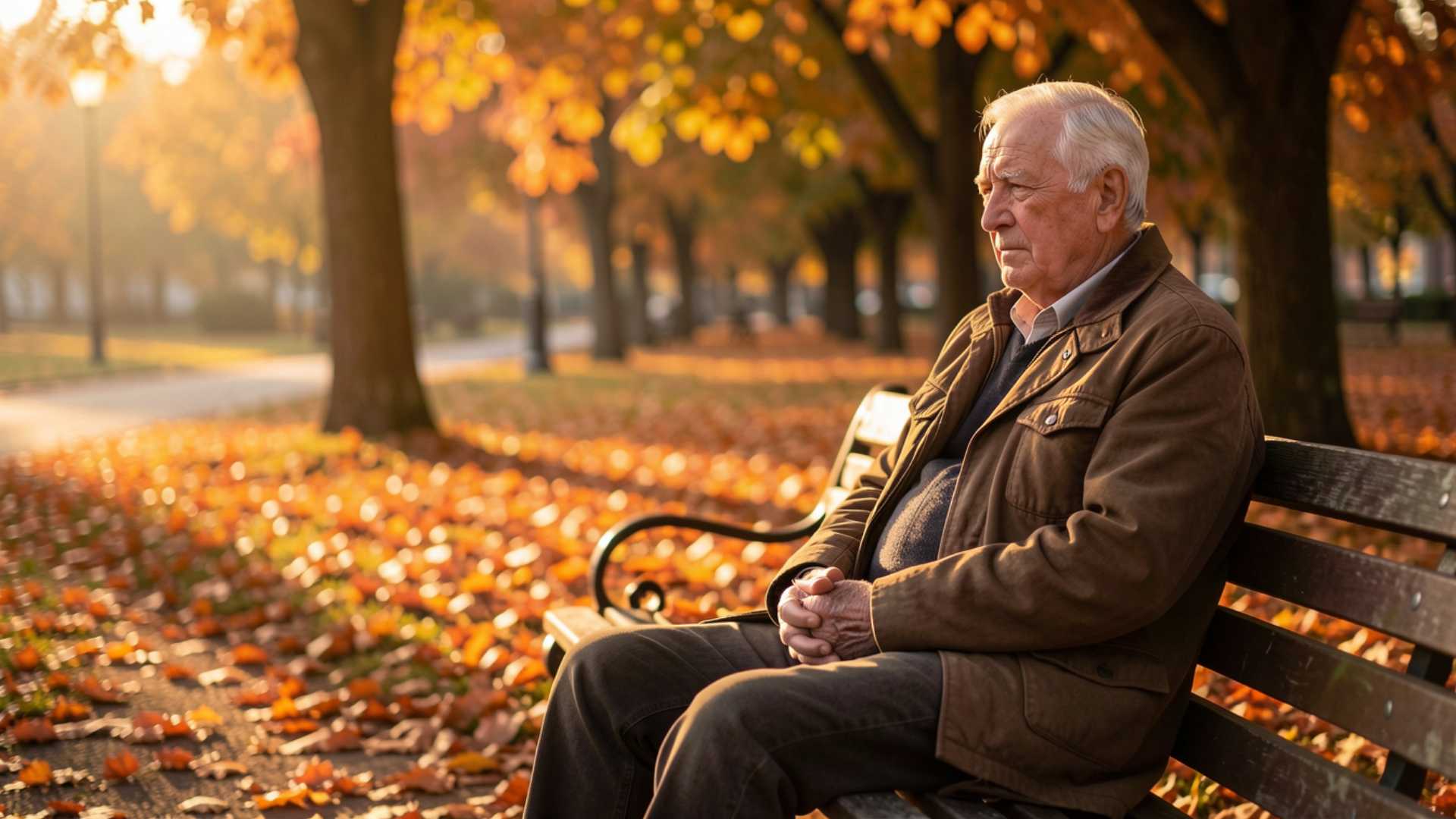
How to Effectively Use Narrative Photography
Narrative photography transforms ordinary images into powerful stories, allowing photographers to convey emotions, contexts, and messages that resonate with audiences. Unlike traditional photography focused on aesthetics or technical precision, this approach emphasizes storytelling through visual elements.
By weaving narratives into photos, you create work that invites interpretation, sparks curiosity, and fosters emotional connections. This guide explores the essence of narrative photography, key techniques, practical tips, and creative ideas to help you craft impactful images.
Understanding Narrative Photography
Narrative photography is the art of using images to tell stories. It goes beyond capturing a moment; it constructs a journey for the viewer, evoking feelings like joy, sadness, or empathy. Each photo acts as a chapter in a visual book, transporting audiences to different experiences or perspectives.
At its core, narrative photography relies on elements like composition, lighting, and subject interaction to communicate a message. It can be concrete, depicting a clear event, or open-ended, leaving room for viewer interpretation. Photographers use deliberate framing, environmental details, and gestures to build “hidden” stories within the frame.
This style draws from human nature’s innate love for storytelling. Narratives bypass logical barriers, altering how we perceive the world. In photography, a single image or series can encapsulate wisdom, emotions, or social insights, much like ancient myths or legends passed through generations.
A narrative differs from a simple story. A story is a chronological sequence of events, while a narrative constructs connections, often without a strict timeline. Psychologist Jerome Bruner emphasized that narratives are durative, involving time and causality. They don’t just connect events; they create them. As Allen Feldman noted, “The event is not what happens. The event is that which can be narrated.” Thus, narratives in photography are constructed by the photographer and interpreted by the viewer, revealing clashes in perspectives.
Photography’s non-verbal nature challenges traditional storytelling, as images freeze a single moment. Yet, they suggest larger tales, especially when viewers bring prior knowledge. For instance, iconic images like Dorothea Lange’s “Migrant Mother” gain power from contextual awareness of economic hardship, evoking shared humanity.
Other examples include Henri Cartier-Bresson’s “Behind the Gare Saint-Lazare,” capturing a “decisive moment” that implies drama, or Alfred Eisenstaedt’s V-J Day kiss in Times Square, where public interpretation often diverges from reality. These photos act as clues, prompting viewers to build their own narratives.
Narrative photography spans genres like photojournalism, documentary, and conceptual work. In street photography, it seizes real-time “decisive moments.” In staged setups, like those by Gregory Crewdson, it deliberately constructs scenes to evoke familiar stories.
The Role of Narrative in Visual Media
Photography evolved alongside other media, expanding narrative possibilities. Early pioneers like Eadweard Muybridge used sequences to study motion, creating literal narratives through juxtaposition. His work, such as a man standing on his hands from a lying position, demonstrated how images in series build progression.
In the 18th century, Gotthold Lessing argued that visual arts imply drama by capturing “pregnant moments”—pivotal instants hinting at before and after. This concept influenced photography’s “decisive moment,” where a single frame suggests a broader tale.
Modern photographers like Duane Michals arrange photo series to explore themes like love, philosophy, and death. David Hockney’s collages, such as his image of his mother at Bolton Abbey, layer perspectives to form multifaceted narratives.
Photo essays and books further enhance narratives. Robert Frank’s “The Americans” sequences images ambiguously, dissecting cultural themes. Darcy Padilla’s “The Julie Project” combines photos with letters and journal entries to document a woman’s life, illustrating poverty’s impact.
Photographs aren’t standalone stories; they complement narratives. They frame ideas, directing attention to emotions or expressions. Interpretation varies with viewer preconceptions, making each image a pointer to personal stories.
To visualize the process of constructing a narrative in photography, consider this flowchart:
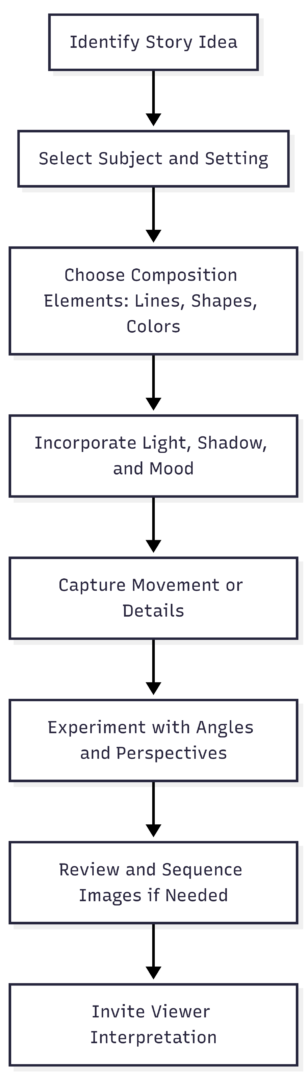
This diagram outlines steps to build a compelling narrative, from conception to final output.
Key Techniques for Narrative Photography
Mastering narrative photography involves techniques that enhance storytelling. Focus on composition to guide the viewer’s eye. Use leading lines to direct attention, or negative space to evoke isolation.
Lighting shapes mood: Soft light creates serenity, while harsh shadows add tension. Movement adds dynamism—freeze action for impact or use blur for momentum.
Details reveal subtleties: Close-ups of textures or expressions uncover hidden layers. Angles alter perception—low angles empower subjects, high angles provide overview.
Juxtaposition creates tension by contrasting elements, like old and new, to spark curiosity. Color influences emotion: Vibrant hues energize, muted tones calm. Black-and-white strips distractions, emphasizing tone and texture for moods like mystery or peace.
Sequences build depth. A series unfolds progression, revealing aspects over multiple frames. Photo essays curate images with context for overarching ideas.
5 Essential Tips for Effective Narrative Photography
To use narrative photography effectively, apply these tips:
- Use Composition to Tell a Story: Composition arranges elements to convey meaning. Place subjects strategically—rule of thirds for balance, or centered for emphasis. Lines guide eyes; shapes and textures add layers. For example, framing a lone figure against a vast landscape suggests solitude.
- Incorporate Movement and Action: Capture dynamics to infuse energy. Freeze a runner mid-stride for progress, or blur traffic for urban chaos. This technique suits sports, wildlife, or street scenes, making images feel alive.
- Focus on Details: Small elements build the narrative. Macro shots of wrinkled hands imply a life story, or patterns in nature highlight beauty. Details connect viewers emotionally, shifting perspectives.
- Use Light and Shadow: Manipulate light for atmosphere. Golden hour softens scenes for warmth; sidelight creates depth. Shadows add mystery—use them to hide or reveal, enhancing drama or serenity.
- Experiment with Angles and Perspectives: Vary viewpoints for uniqueness. Low angles dramatize; overhead shots contextualize. Shoot through reflections or from unusual spots to uncover new details.
Here’s a table summarizing these tips with practical applications:
| Tip Number | Tip Description | Practical Application | Example Genre |
|---|---|---|---|
| 1 | Use Composition to Tell a Story | Arrange elements to guide viewer eye flow | Portrait, Landscape |
| 2 | Incorporate Movement and Action | Freeze or blur motion for dynamism | Sports, Street |
| 3 | Focus on Details | Highlight textures or small objects | Macro, Documentary |
| 4 | Use Light and Shadow | Manipulate for mood enhancement | All genres |
| 5 | Experiment with Angles | Try low, high, or unconventional views | Conceptual, Travel |
5 Creative Ideas for Narrative Photography
Spark your practice with these ideas:
- Tell a Story with a Series of Images: Use multiple photos around a theme, like a day’s journey. This builds cohesion, revealing progression without relying on one shot.
- Capture Everyday Moments: Document routines—morning coffee or family interactions—for authentic narratives. Focus on unique details to celebrate life’s beauty.
- Use Juxtaposition: Contrast elements, like wealth and poverty side-by-side, to create tension. Experiment with colors, shapes, or subjects for intrigue.
- Use Color to Enhance the Story: Select palettes for impact—bold for energy, subtle for calm. Complement subjects to reinforce messages.
- Create a Mood with Black and White: Remove color to emphasize tone. Dark contrasts evoke mystery; bright ones suggest peace.
Table of ideas with implementation steps:
| Idea Number | Idea Description | Implementation Steps | Potential Outcome |
|---|---|---|---|
| 1 | Series of Images | Plan theme, shoot sequence, edit for flow | Cohesive visual journey |
| 2 | Everyday Moments | Observe routines, capture details intentionally | Relatable, authentic stories |
| 3 | Juxtaposition | Identify contrasts, frame together | Visual tension and curiosity |
| 4 | Use Color | Choose palette based on emotion | Enhanced emotional depth |
| 5 | Black and White | Convert images, adjust contrast | Focused mood and texture |
Contemporary Examples and Artworks
Contemporary photographers exemplify narrative techniques. Yevgeniy Repiashenko’s works blend surrealism and emotion:
- “Elan”: 120 x 120 x 0.1 cm, $2620 – Captures ethereal figures in motion, suggesting personal transformation.
- “Asphodel”: 120 x 120 x 0.1 cm, $2620 – Uses soft tones for mythical narratives.
- “Lotus”: 100 x 100 x 3 cm, $3700 – Symbolizes rebirth through floral elements.
- “No77 Spirit”: 91 x 91 x 0.1 cm, $1475 – Explores spiritual themes with abstract forms.
- “No81 Spirit Series”: 90 x 63 x 0.1 cm, $1475 – Sequences ethereal presences.
- “Veris”: 120 x 120 x 0.1 cm, $2620 – Evokes seasonal change as metaphor.
Brooke Shaden’s conceptual pieces delve into fantasy:
- “Limitless”: 50 x 50 x 0.1 cm, $2500 – Portrays boundless exploration.
- “The Sky Is Burning”: 100 x 100 x 0.1 cm, $5200 – Conveys apocalyptic tension.
- “Speck”: 100 x 100 x 1 cm, $5200 – Highlights insignificance in vastness.
- “The Sky Is Burning – Size M”: 50 x 50 x 0.1 cm, $2400 – Scaled version for intimate viewing.
- “The Sound of Flying Souls”: 50 x 50 x 0.1 cm, $2400 – Suggests ethereal departure.
- “Borrowed Time”: 50 x 50 x 0.1 cm, $2400 – Explores mortality.
Table of selected artworks:
| Artist | Artwork Title | Dimensions (cm) | Price (USD) | Narrative Theme |
|---|---|---|---|---|
| Yevgeniy Repiashenko | Elan | 120 x 120 x 0.1 | 2620 | Transformation |
| Yevgeniy Repiashenko | Lotus | 100 x 100 x 3 | 3700 | Rebirth |
| Brooke Shaden | The Sky Is Burning | 100 x 100 x 0.1 | 5200 | Apocalypse |
| Brooke Shaden | Borrowed Time | 50 x 50 x 0.1 | 2400 | Mortality |
| Yevgeniy Repiashenko | No77 Spirit | 91 x 91 x 0.1 | 1475 | Spirituality |
| Brooke Shaden | Limitless | 50 x 50 x 0.1 | 2500 | Exploration |
These examples show how specifications like size influence intimacy, while prices reflect market value for narrative art.
Advanced Applications: Sequences and Photo Essays
For deeper narratives, use sequences. Muybridge’s motion studies created clear progressions. Michals’ series convey abstract ideas through arrangement.
Photo essays compile images into books or portfolios. Padilla’s project uses multimedia for context, tracking life’s arc. Frank’s work ambiguously critiques society.
To plan a photo essay, follow this diagram:
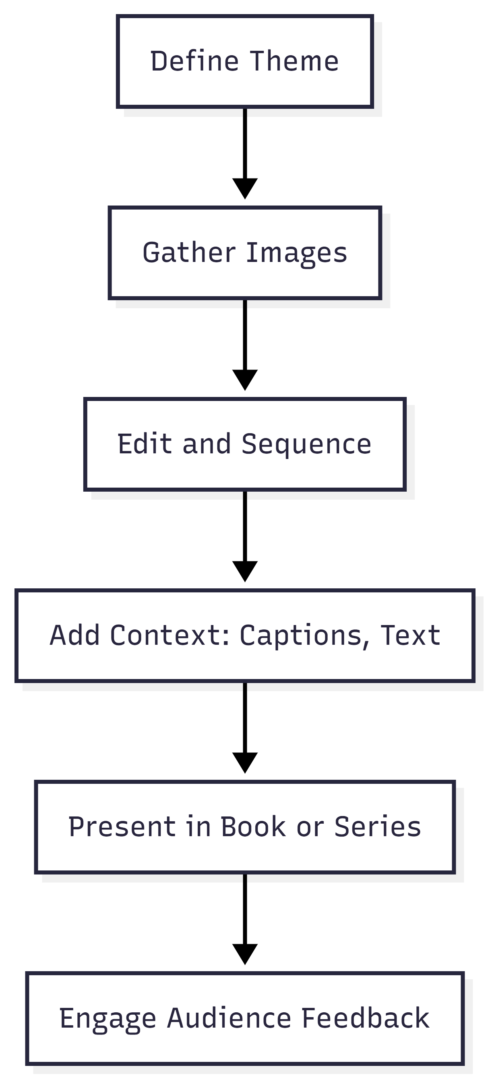
This structure ensures a unified narrative.
Challenges and Considerations
Photography’s temporal limit—freezing one moment—requires implication over explicit telling. Context is key; without it, images may enigma rather than narrate. Encourage viewer participation by leaving gaps.
Social aspects amplify impact: Address themes like identity or inequality to connect broadly.
Conclusion
Narrative photography empowers you to shape perceptions and evoke emotions through images. By mastering composition, light, details, and sequences, you create work that transcends time. Experiment with tips and ideas, draw from examples, and let creativity guide you. Grab your camera, explore surroundings, and craft stories that inspire change. Whether through single shots or essays, narrative photography connects us, reminding of shared experiences.
Please share this How to Effectively Use Narrative Photography with your friends and do a comment below about your feedback.
We will meet you on next article.
Until you can read, Beef and Vegetable Stir-Fry Lettuce Wraps