is google web stories dead
Google Web Stories launched with enormous promise. Publishers were pulling millions of impressions from Google Discover almost overnight. Bloggers in food, travel, and lifestyle niches were treating it like a cheat code for traffic. Then, gradually, the numbers started dropping. Forum posts multiplied. “Web stories dead?” became a recurring search query.
So here is the direct answer: Google Web Stories are not dead, but the era of effortless, explosive traffic is over. What remains is a format that still works, but only under specific conditions, for specific niches, and only when used strategically rather than as a primary traffic channel.
This article breaks down the full picture — what changed, what still works, who it works for, and how to make smarter decisions about whether Web Stories deserve space in your content plan.
What Google Web Stories Actually Are
Google Web Stories are a mobile-first, full-screen visual content format built on the AMP (Accelerated Mobile Pages) framework. They appear as swipeable, tappable slides — combining images, short video clips, text, and audio — displayed across:
- Google Discover (the main traffic source for most publishers)
- Google Search (image-style previews in results)
- Google Images
- Google News (limited access)
Unlike Instagram or Snapchat Stories, Web Stories are hosted on your own domain, indexed by Google, and theoretically discoverable long after publication. That distinction matters enormously for SEO — or at least, it did.
Why Publishers Started Calling Them Dead
The complaints are consistent and widespread across Reddit’s r/SEO, r/Blogging, and Google’s own support forums. They fall into a few clear categories:
1. Traffic Became Wildly Inconsistent
The most common experience: one story gets 40,000 views in 48 hours, the next twenty get fewer than 200 combined. Publishers who built workflows and teams around Web Story production found themselves unable to predict or sustain returns. Unlike evergreen blog posts that accumulate traffic over months, Web Stories perform in short bursts — or not at all.
2. Reduced Discover Visibility
Google Discover is the primary surface where Web Stories appeared. From roughly 2023 onward, many publishers reported a significant reduction in how frequently their Stories were surfaced in Discover feeds. Google never announced a formal algorithm change specifically targeting Stories, but the pattern in publisher data is hard to ignore.
3. The Web Stories Icon Was Removed from Google Images
This was an unambiguous, documented change. Google stopped displaying the dedicated Web Stories icon in Image search, directly reducing one of the three primary discovery surfaces for the format.
4. High Production Cost, Low Monetization Return
Web Stories require visual design skills, high-quality imagery or video, and a meaningful time investment per piece. The payoff — when it comes — tends to be high bounce rates (often above 80%) and low time-on-site, which makes ad revenue and affiliate conversion extremely difficult to optimize. For most publishers, a well-researched 1,500-word blog post delivers more durable, monetizable traffic with less production overhead.
5. The Spam Problem Damaged the Format
As with many Google features, abuse followed adoption. Low-quality, thin, keyword-stuffed Web Stories flooded Google’s index. This almost certainly contributed to Google tightening its Discover distribution for the format, hurting quality publishers in the process.
Why Google Web Stories Are Still “Alive”
Despite all of the above, the format is not discontinued. Here is what remains true:
Google continues to actively index and surface Web Stories. Publishers in the right niches, producing quality content, still report meaningful Discover traffic. The format did not die — its floor dropped and its ceiling became harder to reach.
The format remains particularly effective in specific markets. Google continues to actively promote Web Stories in the United States, India, and Brazil — three of its largest Discover markets. Publishers in those regions targeting those audiences still have more opportunity than those targeting smaller markets.
Ownership remains a genuine advantage. Unlike platform-native Stories on Instagram or TikTok, Web Stories live on your domain. You control the monetization, the data, and the SEO value. If a story ranks in Google Search or Images, that traffic compounds over time in a way that social stories never can.
Niche alignment still matters more than format. Travel, food, fashion, home décor, and lifestyle content — all heavily visual, all suited to mobile consumption — still perform meaningfully in Web Stories format when executed well.
The Data Reality: What the Numbers Show
| Metric | Early Web Stories Era | Current State |
|---|---|---|
| Average bounce rate | 70–80% | 80–90% |
| Average session duration | 10–20 seconds | 10–15 seconds |
| Discover visibility | High and consistent | Inconsistent, niche-dependent |
| Google Images presence | Dedicated icon shown | Icon removed |
| Monetization viability | Low-moderate | Low |
| SEO indexing | Active | Still active |
| Format support from Google | Full | Continued but quieter |
Who Should Still Use Google Web Stories
The question is not whether Web Stories “work” in the abstract — it is whether they work for your specific situation. Here is a practical breakdown:
Good Candidates
- Visual niche publishers in food, travel, fashion, home, fitness, and beauty
- Publishers already producing visual content (photography, video) who can repurpose assets into Stories without significant extra work
- Sites targeting India, Brazil, or the U.S. where Google Discover Story visibility remains stronger
- Brands focused on mobile awareness rather than conversion — Stories are effective for brand recall even when they fail at driving purchases
- Publishers treating Stories as a supplementary channel, not a primary one
Poor Candidates
- Sites primarily targeting desktop audiences — Web Stories are built for mobile and deliver poor desktop experiences
- Publishers in non-visual niches like finance, B2B software, legal, or technical fields
- Sites without design resources — low-quality visual Stories actively harm brand perception
- Anyone expecting consistent, predictable traffic — the format’s volatility makes it unusable as a forecasting tool
- Publishers trying to monetize heavily through display ads — the bounce rates make it economically marginal
How to Create Web Stories That Still Perform
If you fall into the “good candidate” category, the tactics that separate high-performing Stories from invisible ones are well-established.
Timing and Topic Selection
Web Stories that surface in Discover tend to align with trending topics or high-volume evergreen searches. Before creating a Story, validate the keyword or topic has genuine search demand. A Story on “best hiking trails in Patagonia” has far more potential than one on “why we love hiking” — specificity and search intent matter.
Structure for Swipeability
Every Web Story should follow a clear arc. This is not about being artistic — it is about reducing your bounce rate.

The hook must work in under two seconds on mobile. If the first slide does not immediately communicate value, users swipe away.
Visual Quality is Non-Negotiable
The average Web Story viewer spends 10–15 seconds on the entire experience. Blurry images, cluttered text, or low-contrast design destroys performance. Every slide should be:
- High-resolution (minimum 720p for images, 1080p for video)
- Text-minimal — no more than 280 characters per slide
- Brand-consistent — fonts, colors, and tone should match your site identity
SEO Optimization Inside the Story
Because Web Stories are indexed by Google, on-page SEO still applies:
- Include the primary keyword in the Story title
- Write a descriptive, keyword-rich meta description for the Story URL
- Add alt text to every image
- Use structured data markup (the Web Story schema is auto-generated by most WordPress plugins, but verify it with Google’s Rich Results Test)
- Link internally from the Story to your main article on the topic
Video Length
Keep embedded video clips to 15 seconds or less per slide. Longer clips reduce completion rates and hurt your Story’s performance signals.
Posting Frequency
Publishers who see consistent results typically maintain a cadence of at least two to four Stories per week. Single Stories posted occasionally almost never gain traction — the format rewards publishers who signal consistent, ongoing production to Google’s systems.
Tools for Building Web Stories
| Tool | Best For | Cost |
|---|---|---|
| MakeStories | Dedicated Web Story editor, WordPress integration | Free tier available; paid from ~$9/month |
| Newsroom AI | Fast, template-driven Story creation | Paid, pricing varies |
| WordPress Web Stories Plugin (by Google) | Native WordPress users | Free |
| Canva + Manual Upload | Designers who prefer manual control | Free/Pro from $15/month |
| Unfold | Mobile-first creation | Free/Pro from $2.99/month |
The Google-built WordPress plugin remains the most accessible starting point for most publishers. It handles schema markup automatically, integrates with Google Analytics, and supports AdSense placement.
The Seasoning Problem: Early vs. Late Optimization
One of the most misunderstood aspects of Web Story performance is when to optimize — which mirrors a broader content strategy principle worth addressing directly.
Many publishers launch Stories with minimal metadata, treat them as “post and forget” content, and then wonder why performance is inconsistent. The reality is that Web Stories benefit from two phases of optimization:
Early (at publication): Title, meta description, alt text, internal links, and structured data must all be in place before the Story is submitted to Google’s index. These are your foundational signals — getting them wrong at launch costs you Discover distribution before the algorithm even has a chance to evaluate your content.
Late (after initial performance data): If a Story gets early traction in Discover, that is the moment to update the CTA slide, strengthen the internal link to your main article, and consider promoting it through your social channels to amplify the signal. Stories that gain momentum in the first 48 hours tend to sustain longer — publishers who actively support that window outperform those who publish and move on.
This is the same principle that applies to any content format: the structure sets the ceiling, but active management determines how close you get to it.
The Verdict: A Supplementary Channel, Not a Core Strategy
Google Web Stories evolved from a genuine traffic opportunity into a niche supplementary channel. The trajectory is clear:
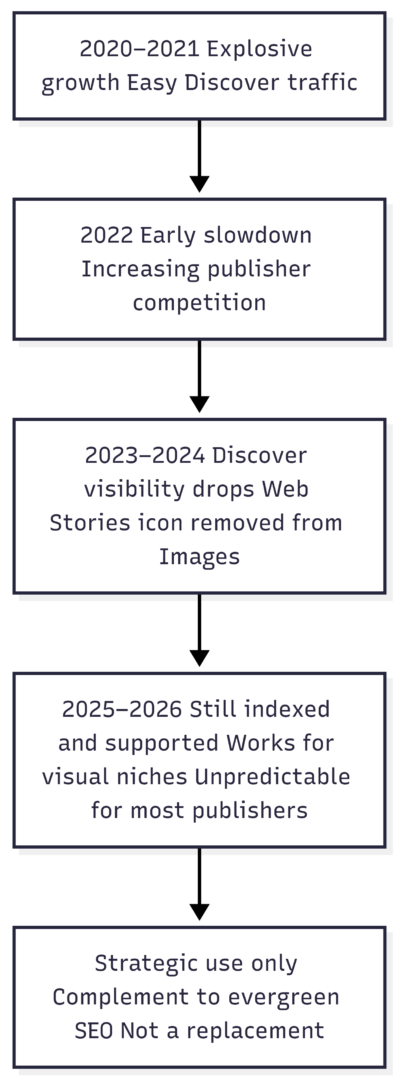
For publishers who invest in Web Stories as their primary growth channel, the math rarely works. The bounce rates are too high, the monetization is too thin, and the traffic is too unpredictable to build a business on.
For publishers who treat Web Stories as a mobile-optimized complement to strong evergreen content — a way to introduce new audiences to a topic, then funnel them toward the full article — the format still has real value.
The key shift is expectations. Web Stories are no longer a growth hack. They are a brand awareness and mobile engagement tool that occasionally drives meaningful traffic, housed on your own domain with your own SEO equity. Used occasionally, with quality production and realistic expectations, they remain worth the investment. Used as a core strategy, they will consistently underdeliver.
Quick Reference: Web Stories Decision Framework
| Question | Yes | No |
|---|---|---|
| Is your niche heavily visual? | Consider it | Skip for now |
| Do you target mobile-heavy audiences? | Consider it | Skip for now |
| Do you have design resources? | Consider it | Skip for now |
| Are you in the U.S., India, or Brazil? | Higher opportunity | Lower opportunity |
| Can you publish 2–4 Stories per week? | Sustainable | Too inconsistent |
| Do you need predictable traffic forecasts? | Use evergreen SEO instead | — |
| Are you already producing video/photo content? | Strong repurposing case | High production cost |
Google Web Stories are not dead. But they are no longer the guaranteed traffic driver they were in their early years. Approach them with clear-eyed expectations, use them to complement your main content strategy rather than replace it, and focus your production energy on the niches and formats where the format still demonstrably performs. That is the honest, practical answer for publishers in 2025–2026.
Please share this is google web stories dead with your friends and do a comment below about your feedback.
We will meet you on next article.
Until you can read, How to fix the ISO 8601 warning