SEO for Food Bloggers [Get More Traffic & Rankings]
Food bloggers face intense competition in Google search results. Recipes for chocolate chip cookies, gluten-free lasagna, or low-sugar chocolate lava cake appear in millions of results. Yet blogs that master SEO consistently outrank others and attract steady, targeted traffic that converts into readers, subscribers, and revenue.
Optimized food blogs often see 1,000%+ more traffic from search compared to social media or other sources. This long-form guide combines proven strategies—recipe schema markup, long-tail keyword targeting, image optimization, content depth, technical performance, internal linking, and authority building—into one actionable framework. Follow it to create content that search engines love and readers devour.
Why SEO Matters More Than Ever for Food Bloggers
Search engines prioritize helpful, relevant content that matches user intent. For food bloggers, this means delivering complete recipes with clear instructions, substitutions, nutritional info, troubleshooting tips, and personal expertise. Broad keywords like “cake recipe” are highly competitive. Long-tail phrases such as “gluten-free dairy-free lasagna recipe” or “low-sugar chocolate lava cake for beginners” offer realistic ranking opportunities, especially for newer sites.
SEO delivers sustainable growth. Social traffic spikes quickly but fades. Search traffic builds slowly and compounds as you publish more high-quality posts and earn authority signals.
Core On-Page SEO Strategies That Drive Rankings
1. Target Long-Tail, Niche Keywords
75% of search traffic comes from long-tail queries—specific phrases with lower competition but high intent. Use tools to identify them, then build content around them.
Recommended keyword research tools:
- RankIQ: Blogger Plan $49/month (16 SEO reports), Pro $99/month (36 reports). Generates SEO-optimized outlines tailored for bloggers.
- Keysearch: Starter $24/month (200 searches/day), Pro $48/month (500 searches/day). Affordable for tracking and competitor analysis.
- SEMrush: Pro plan ~$117/month billed annually. Powerful for volume, difficulty, and competitor insights.
Place primary keywords naturally in title tags, meta descriptions, H1/H2 headings, and body text. Avoid stuffing—write for humans first.
2. Implement Recipe Schema Markup
Structured data turns plain recipes into rich snippets with prep time, cook time, ingredients, ratings, and nutrition. Google displays these prominently, boosting click-through rates.
Use plugins to add JSON-LD automatically:
- WP Recipe Maker (free core; Premium Bundle $49/year for 1 site, Pro $99/year).
- Tasty Recipes by WP Tasty (Basic $49/year for 1 site, includes schema, beautiful cards, and Pinterest optimization).
Both generate proper recipe schema covering prepTime, cookTime, recipeIngredient, recipeInstructions, and aggregateRating.
3. Optimize Images and Videos for Speed and Relevance
Food photography is central to recipes, but large files slow load times. Google penalizes slow sites, especially on mobile.
Best practices:
- Rename files descriptively:
gluten-free-lasagna-recipe.jpginstead ofDSC_0078.jpg. - Add keyword-rich alt text: “Step-by-step gluten-free dairy-free lasagna with melted cheese.”
- Compress images (target <100 KB for most recipe photos) using tools like ImageOptim or built-in plugin compressors.
- Use JPEG for photos, PNG for graphics/logos.
- Host videos on YouTube with keyword-rich titles and descriptions for additional traffic.
Aim for full page load under 2 seconds. This directly improves rankings and user experience.
4. Create Comprehensive, E-E-A-T Content
Google evaluates Experience, Expertise, Authoritativeness, and Trustworthiness (E-E-A-T). Food blogs demonstrate this through:
- Detailed step-by-step instructions with photos at each stage.
- Ingredient substitutions, common mistakes, and troubleshooting.
- Nutritional information and dietary adaptations.
- Author bio showing real kitchen testing and years of recipe development.
- High-quality user reviews and comments.
Target 1,000–1,900 words per post. Include internal links to related recipes, external links to credible sources (e.g., ingredient guides), and proof of testing (e.g., “I tested 12 variations so you don’t have to”).
This is “10x content”—material noticeably better than top-ranking results. Research competing posts, then add unique value: flavor variations, make-ahead tips, or pairing suggestions.
5. Perfect URL Structure
Keep URLs short, readable, and keyword-focused.
Good: yourblog.com/gluten-free-lasagna-recipe
Bad: yourblog.com/2020/recipe-23432
Descriptive URLs help both users and search engines understand page content instantly.
Technical SEO Foundations
Mobile-First Design and Site Speed
Most recipe searches happen on phones. Ensure responsive design and Core Web Vitals compliance. Use caching plugins like WP Rocket (Single $59/year for 1 site, Plus $119/year for 3 sites) to achieve sub-2-second loads.
Internal Linking and Recipe Clusters
Build topical authority by grouping related recipes. A “Mexican Cuisine” cluster might include enchiladas, tacos, salsa, and a hub page linking them all.
Recipe Cluster Building Process:
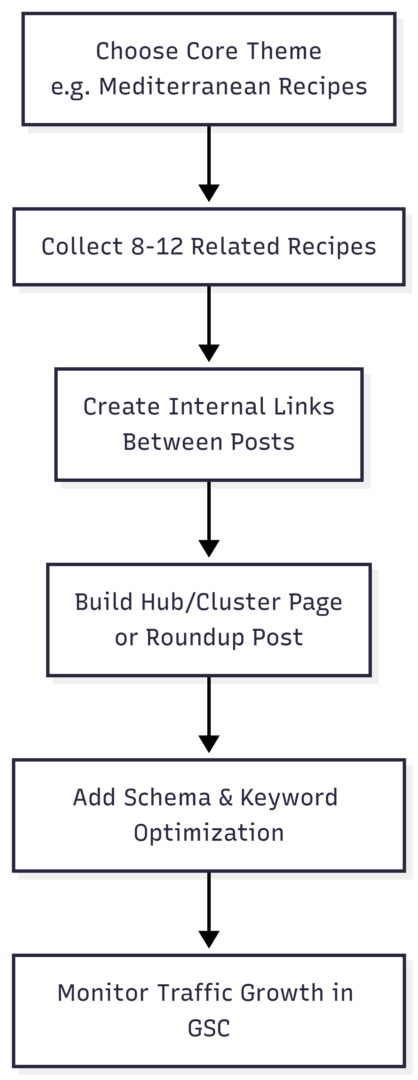
This interconnected structure helps Google understand your site’s expertise while guiding readers to more content.
Use plugins like Tasty Roundups or Tasty Links (included in WP Tasty All Access $349/year) to automate relevant linking without manual effort.
Tools Every Food Blogger Needs
| Tool | Pricing (Annual unless noted) | Key Specifications for Food Bloggers | Best For |
|---|---|---|---|
| RankIQ | Blogger $49/mo; Pro $99/mo | 16-36 SEO reports/month; AI outlines; low-competition keywords | Keyword research & outlines |
| Keysearch | Starter $24/mo; Pro $48/mo | 200-500 searches/day; rank tracking; competitor analysis | Budget keyword research |
| WP Recipe Maker | Free core; Premium $49/yr (1 site) | Full recipe schema, nutrition calculator, print buttons | Beginners & schema markup |
| Tasty Recipes (WP Tasty) | Basic $49/yr (1 site) | Beautiful cards, schema, Pinterest-ready images, monetization | Growing food blogs |
| SEMrush | Pro ~$117/mo (billed annually) | Keyword magic tool, site audit, content analyzer | Competitor & advanced research |
| WP Rocket | Single $59/yr (1 site); Multi $299/yr (50) | Caching, lazy load, image optimization | Site speed |
| AIOSEO | Basic ~$49.50/yr (1 site); Pro $199.50/yr | TruSEO analysis, schema, redirects, link assistant | On-page SEO automation |
Choose based on budget and scale. Start with free WP Recipe Maker + Keysearch, then upgrade as traffic grows.
Building Authority and Earning Links Naturally
Links remain a major ranking factor. Focus on earning them through high-quality content rather than buying or exchanging.
- Guest post on reputable food sites with a link back to your recipe.
- Create shareable resources (e.g., “Ultimate Guide to Chocolate Chip Cookies” with extensive testing data).
- Encourage reader reviews and social shares.
- Get featured in roundups or news outlets.
Avoid spammy tactics—Google penalizes low-quality links.
Measure, Refresh, and Iterate
Install Google Search Console (GSC) and Google Analytics. Track:
- Queries driving traffic
- Click-through rates
- Impressions vs. clicks
- Top-performing pages
Use GSC to identify declining posts, then refresh with updated images, new tips, fresh schema, and expanded content. This re-ignites rankings without starting from scratch.
Monitor mobile performance and bounce rates—recipes that load fast and deliver value keep readers engaged longer.
Common Pitfalls to Avoid
- Keyword stuffing or thin content (under 800 words).
- Ignoring mobile speed or image compression.
- Orphaned recipes without internal links.
- Copying competitors instead of adding unique expertise.
- Neglecting schema or alt text.
Action Plan to Implement Today
- Audit your top 10 posts in GSC for opportunities.
- Install a recipe plugin (WP Recipe Maker or Tasty Recipes) and add schema to existing content.
- Research 5 long-tail keywords for your next post using RankIQ or Keysearch.
- Write a 1,200+ word recipe post with step-by-step photos, substitutions, and E-E-A-T signals.
- Optimize images, create internal links to 3 related recipes, and build a small cluster hub.
- Submit updated sitemap to GSC and monitor performance over 4-6 weeks.
Consistent application of these strategies compounds. One well-optimized recipe cluster can drive traffic for years.
SEO for food bloggers is not about tricks—it’s about creating genuinely helpful, beautifully presented content that search engines can understand and readers love to share. Start with recipe schema and long-tail keywords, layer in technical speed and clusters, and watch your traffic grow steadily.
Implement these tactics, track results, and refine. Your next viral recipe is waiting in the search results—now go earn it.
Please share this SEO for Food Bloggers [Get More Traffic & Better Rankings] with your friends and do a comment below about your feedback.
We will meet you on next article.
Until you can read, How do I find my best or worst performing Pinterest Boards?