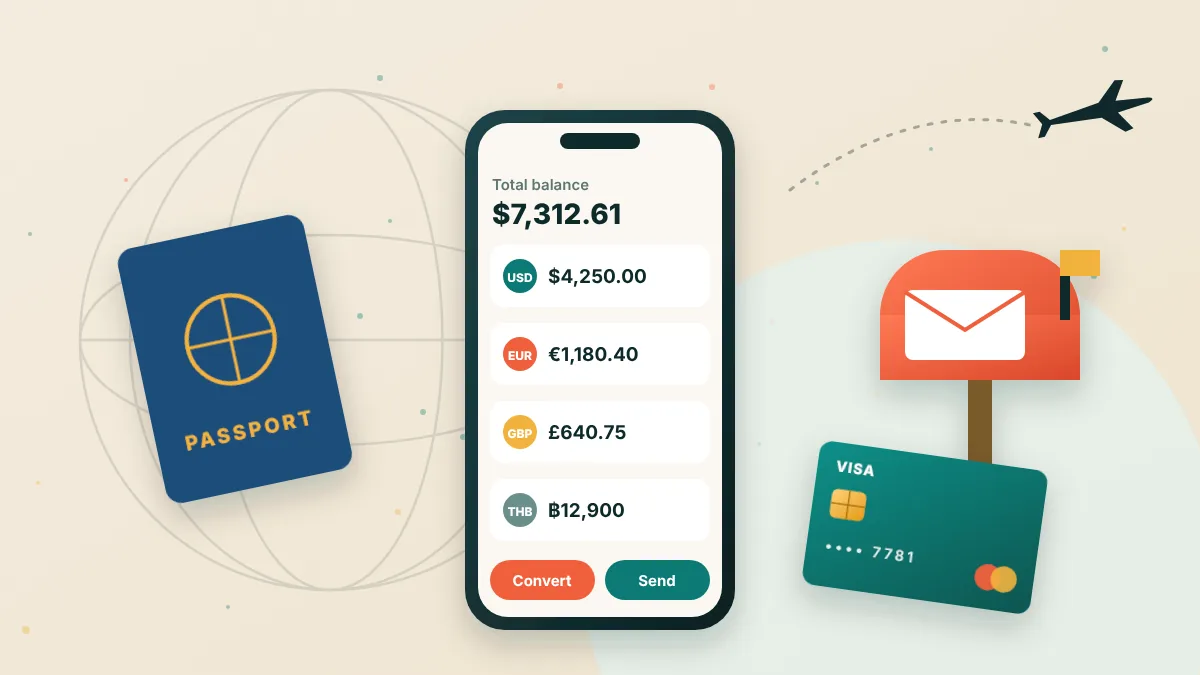
Alternative bank solutions for digital nomads replace (or back up) a traditional bank with tools built for life abroad: multi-currency accounts like Wise, app-based banks like Revolut, freelancer payment platforms like Payoneer, brokerage cash accounts, and a virtual mailbox to solve the “no home address” problem. Used together, they cut foreign fees, let you get paid in several currencies, and keep your money reachable when a bank card gets blocked at 2 a.m. in a new country.
In this guide
Why traditional banks fail digital nomads
High-street banks were designed for customers who live at one address and spend in one currency. Nomads run into the same problems again and again:
- Foreign transaction and ATM fees on every purchase and withdrawal.
- Fraud blocks when you log in or spend from a new country.
- SMS verification codes sent to a home phone number you no longer use.
- Address checks — banks may close or restrict accounts if they learn you no longer live at the address on file.
- Slow, expensive international transfers when clients pay you from abroad.
The good news: each of these has a well-tested workaround.
7 alternative bank solutions for digital nomads
1. Multi-currency accounts (Wise)
A multi-currency account lets you hold, convert and spend dozens of currencies from one app. Wise is the best-known: it converts at the mid-market exchange rate with a visible fee (from about 0.23%), supports 40+ currencies and gives you local account details in major currencies such as USD, EUR and GBP. That means a client in Germany can pay you in euros as if you had a German bank account.
Use it for: receiving payments, paying rent abroad, and spending in local currency with no foreign transaction fee.
2. App-based banks (Revolut, N26, Starling)
Neobanks run entirely through an app, which makes them easier to manage from abroad: you can freeze a card, change limits or chat with support in seconds. Revolut is strong for frequent currency exchange, while N26 (eurozone) and Starling (UK) are licensed banks that are popular with European nomads. Compare their fees in our best banks for digital nomads guide.
3. Brokerage cash accounts (Fidelity, Schwab)
For US citizens, the most nomad-friendly “bank accounts” are often run by investment firms. Fidelity’s Cash Management Account refunds ATM fees worldwide, and Schwab Bank Investor Checking offers unlimited worldwide ATM rebates with no foreign transaction fees. Both have no monthly fee.
4. Freelancer payment platforms (Payoneer, PayPal)
If you sell on marketplaces or invoice clients around the world, a payment platform can sit between your clients and your bank. Payoneer is free to receive into a local-currency receiving account and from other Payoneer users, but it charges a $29.95 annual fee if you receive less than $6,000 in 12 months, and currency conversion on withdrawals can cost 1.2%–4%.
PayPal is convenient but its conversion costs are usually higher than Wise’s — compare before you rely on either. See our 5 alternative bank accounts for nomads who get paid from abroad for a side-by-side comparison.
5. Travel credit cards with no foreign transaction fee
A good travel credit card is your best everyday payment method abroad: purchase protection, no foreign fees, and often built-in trip insurance. Cards like the Chase Sapphire Preferred, Capital One Venture X and Citi Strata Premier charge no foreign transaction fees. Here’s our list of credit cards that provide travel insurance.
6. A virtual mailbox and a stable “home” address
Most banks need a residential address, and many send cards and tax forms by post. Nomads usually solve this with a virtual mailbox service that scans your mail and forwards cards to you abroad.
Some full-time US travelers also establish residency in a state that is friendly to full-time RVers and travelers — see our guide to the best US states and places to live for low taxes. Be honest with your bank about your situation: a virtual mailbox is fine for receiving post, but some banks do not accept it as a residential address.
7. Stablecoins and crypto (use with caution)
Some nomads are paid in USD stablecoins and convert to local currency when needed. It can be fast for cross-border payments, but it adds risks — exchange failures, account freezes, tax reporting and volatility on non-stablecoin assets. Treat it as an extra tool, not a replacement for a regulated bank account.
How to build your alternative banking setup (step by step)
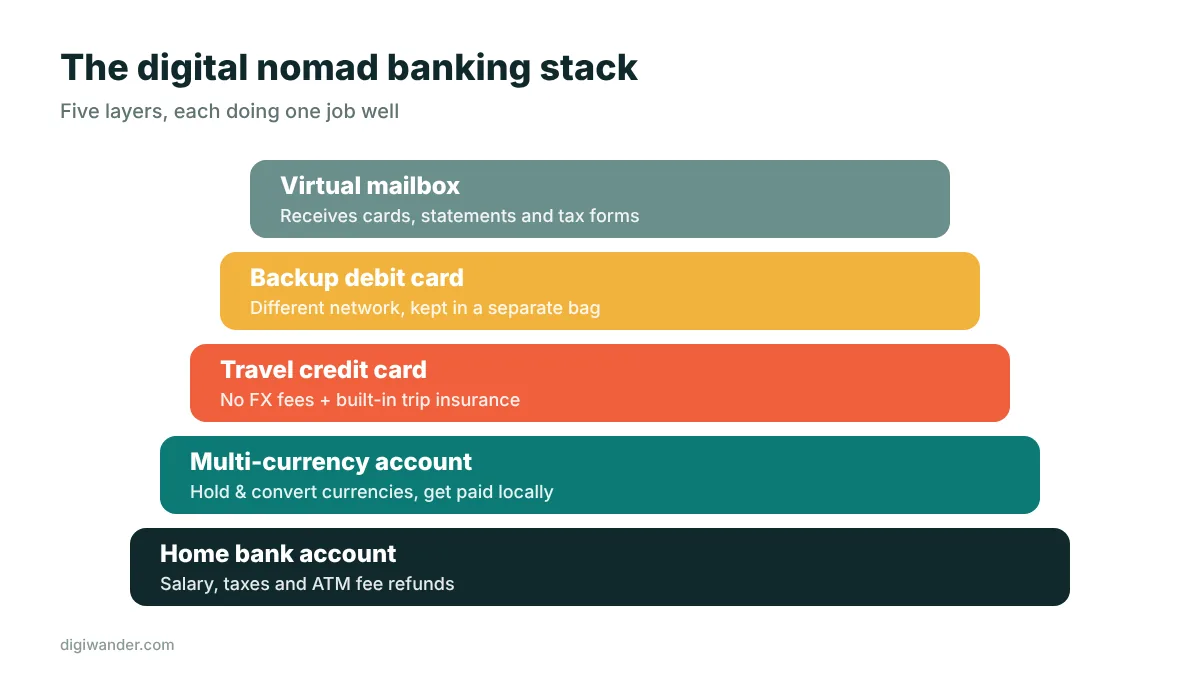
- Keep one account in your home country for taxes, salary and anything that needs a local account.
- Open a multi-currency account (Wise or Revolut) before you leave — verification is easier with a home address and phone number.
- Get at least two debit cards on different networks (one Visa, one Mastercard) and keep them in separate bags.
- Carry a no-foreign-fee credit card for daily spending and bookings.
- Switch two-factor authentication to an app wherever possible, or keep your home number active with a cheap plan or eSIM.
- Set up a virtual mailbox before you give up your home address.
| Problem | Alternative solution | Example tools |
|---|---|---|
| Foreign transaction fees | No-FX-fee debit and credit cards | Schwab, Fidelity, Wise, travel credit cards |
| ATM fees abroad | Accounts that refund ATM fees | Fidelity CMA, Schwab Investor Checking |
| Getting paid in foreign currencies | Local account details in many currencies | Wise, Payoneer |
| Card blocked or lost | Backup card on another network | Revolut, Capital One 360 |
| No fixed home address | Virtual mailbox + residency planning | Mail-scanning services |
Important: Rules on who can open an account depend on your citizenship and country of residence, and fees change often. Check each provider’s current terms, and speak to a tax professional about where you are tax-resident before you move abroad long-term.
Frequently asked questions
What is alternative banking for digital nomads?
It means using tools such as multi-currency accounts (Wise), app-based banks (Revolut, N26), payment platforms (Payoneer) and brokerage cash accounts instead of, or alongside, a traditional high-street bank.
How do digital nomads handle bank mail without a home address?
Many use a virtual mailbox service that scans mail and forwards cards abroad, or keep a family member’s address. Some banks do not accept a virtual mailbox as a residential address, so check your bank’s rules.
How do I receive bank verification codes abroad?
Switch two-factor authentication to an authenticator app or in-app approval where possible. If your bank only uses SMS, keep your home number active with a cheap plan, number-porting service or eSIM.
Are fintech accounts like Wise and Revolut safe?
They are regulated, but protection rules differ from bank deposits and vary by country. Use them for everyday money and currency, and keep larger savings at a fully licensed bank.
Can digital nomads get paid in multiple currencies?
Yes. Wise and Payoneer provide local receiving details in major currencies such as USD, EUR and GBP, so clients can pay you with a local transfer instead of an international wire.
Sources
- Wise — Pricing
- Payoneer — Fees
- FDIC — Deposit insurance (how fintech balances may or may not be covered)
Last updated . Fees, rules and prices change often — confirm current details with the official source before you act. This article is for information only and is not financial advice. See our disclaimer.