Portugal’s D8 digital nomad visa lets non-EU remote workers and freelancers live in Portugal while working for clients or employers abroad. In 2026 you need to earn at least €3,680 a month (four times Portugal’s €920 minimum wage) and usually show savings of about €11,040. There are two versions: a temporary-stay visa for up to one year, and a residence visa that leads to a two-year residence permit, renewable for three years, and a possible path to permanent residency after five years.
In this guide
Who can apply for the D8 visa?
- Citizens of countries outside the EU, EEA and Switzerland.
- Remote employees working for a company outside Portugal.
- Freelancers and business owners whose clients are mainly outside Portugal.
- People who can prove a stable income at or above the threshold.
The D8 is different from the D7, which is for passive income such as pensions, rental income or dividends.
Portugal digital nomad visa (D8) requirements in 2026
| Requirement | Details |
|---|---|
| Minimum income | €3,680 per month (4 × €920 minimum wage), usually shown over the last 3 months |
| Savings | About €11,040 in your bank account |
| Family | +50% income for a spouse or adult dependent, +30% per child |
| Proof of remote work | Employment contract or freelance contracts and invoices |
| Portuguese tax number | NIF (número de identificação fiscal) |
| Accommodation | Lease or booking in Portugal |
| Health insurance | Travel or health insurance valid in Portugal |
| Criminal record | Apostilled certificate from your country (and countries of recent residence) |
| Passport and photos | Valid passport, recent photos, signed application form |
Based on 2026 requirements reported by MCS Portugal. Income thresholds follow the minimum wage and change each year — confirm with your consulate.
Temporary-stay vs residence visa
| Temporary-stay D8 | Residence D8 | |
|---|---|---|
| Length | Up to 1 year, multiple entries | 4-month entry visa, then a residence permit |
| Residence permit | No | 2 years, renewable for 3 years |
| Path to permanent residency | No | Possible after 5 years of legal residence |
| Best for | Trying Portugal for a year | Moving to Portugal long term |
How to apply for the D8 visa, step by step
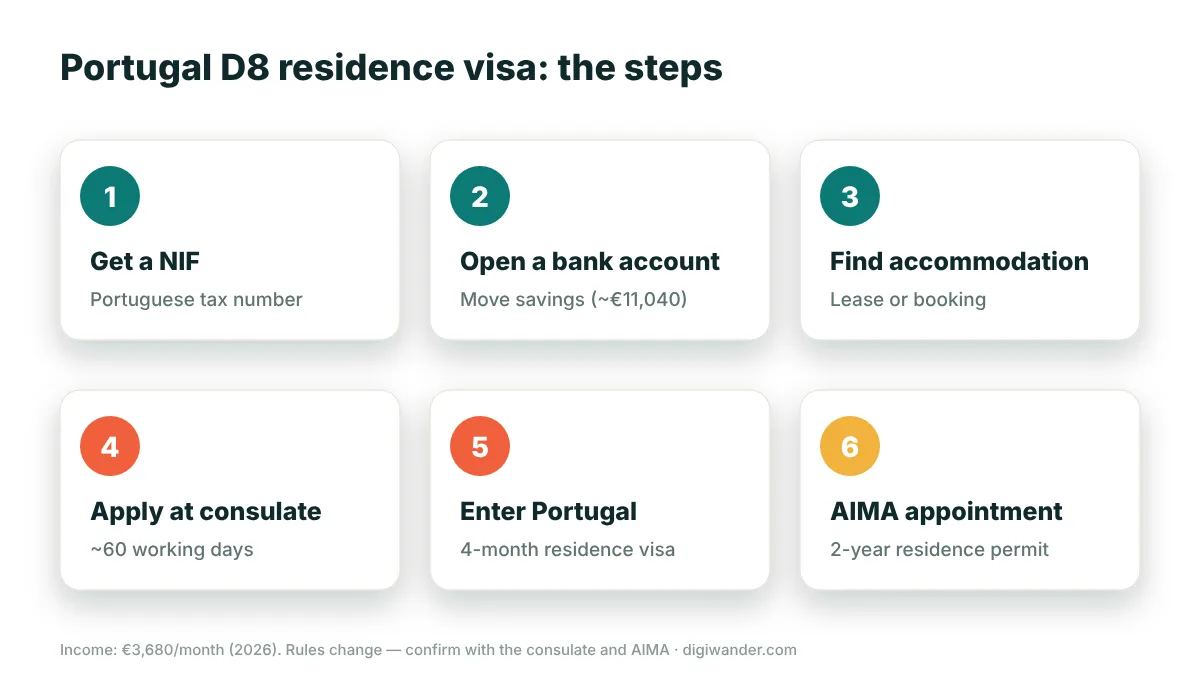
- Get a NIF (Portuguese tax number) — often through a lawyer or fiscal representative if you are abroad.
- Open a Portuguese bank account and move your savings there if required.
- Arrange accommodation in Portugal.
- Gather documents: income proof, contracts, bank statements, insurance, apostilled criminal record.
- Apply at the Portuguese consulate (or its visa provider) in your country of legal residence. Processing commonly takes around 60 working days.
- Enter Portugal on the residence visa.
- Attend your AIMA appointment to receive a two-year residence permit.
- Renew for three years — renewal generally expects you to have spent most of your time in Portugal.
How much does living in Portugal cost?
Lisbon and Porto have become expensive for rent, while smaller cities and the interior are cheaper. As a rough guide, a single person living comfortably in Lisbon should budget well above the €3,680 visa threshold for rent-heavy areas; cities like Braga or Coimbra cost less. Use our digital nomad budget guide to work out your number, and compare cities on Nomad List.
Taxes in Portugal for D8 holders
If you spend more than 183 days in Portugal in a 12-month period, or keep a habitual home there, you generally become a Portuguese tax resident and are taxed on worldwide income. The old NHR regime has been replaced by IFICI (sometimes called NHR 2.0), which offers a flat 20% rate for eligible high-value activities for up to ten years — but eligibility depends on your activity, and many remote workers will not qualify. Speak to a Portuguese tax adviser before you move.
Important: Immigration rules, fees and processing times change often. This guide is general information, not legal advice. Always check the official requirements with the Portuguese consulate and AIMA, or work with a qualified immigration lawyer.
Comparing Portugal with other countries? See our complete list of digital nomad visas by country.
Banking and money for your move
You will need to move money from home and pay rent in euros. A multi-currency account helps avoid conversion fees — compare options in our best banks for digital nomads guide. Need a remote income first? Start with the best websites to find remote work.
Frequently asked questions
How much income do I need for Portugal’s D8 visa in 2026?
You need at least €3,680 a month, which is four times Portugal’s €920 minimum wage, usually shown over the previous three months. Families need more.
How long does the Portugal D8 visa last?
The temporary-stay D8 lasts up to one year. The residence D8 is a four-month entry visa that leads to a two-year residence permit, renewable for three years.
Can the D8 visa lead to permanent residency?
The residence route can lead to permanent residency after five years of legal residence, and possibly citizenship under Portugal’s nationality rules. The temporary-stay route does not.
Do I pay tax in Portugal on a D8 visa?
If you spend more than 183 days a year in Portugal or keep a habitual home there, you generally become tax resident and are taxed on worldwide income. Get advice from a Portuguese tax adviser.
Can freelancers apply for the D8 visa?
Yes. Freelancers and business owners can apply if their clients are mainly outside Portugal and they meet the income requirement.
Sources
- MCS Portugal — How to apply for a D8 visa in 2026
- Portuguese Ministry of Foreign Affairs — Visa portal
- The Local — Digital nomad visa income requirements compared
Last updated . Fees, rules and prices change often — confirm current details with the official source before you act. This article is for information only and is not financial advice. See our disclaimer.