yum
How Long Can Cooked Food Sit Out?

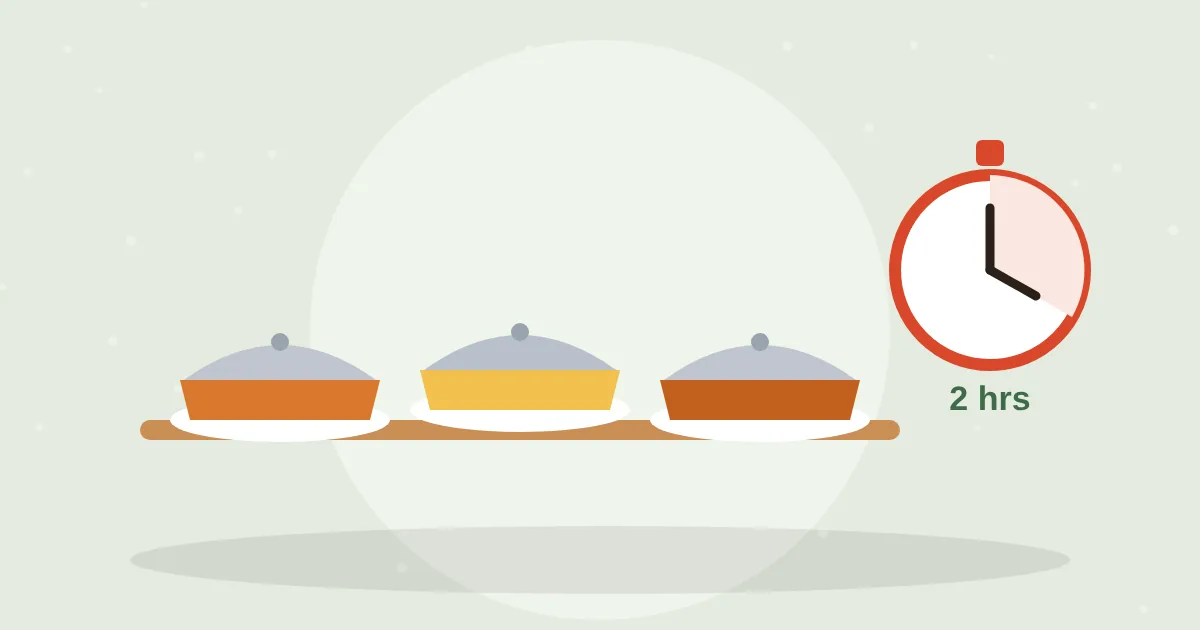
The food is out, the guests are eating, and the conversation keeps going. But how long can cooked food sit out before it becomes unsafe? The answer is the same for almost everything you cook: 2 hours. This simple guideline – the 2-hour rule – is the single most important food safety habit in any kitchen.
This guide explains why the rule exists, when it shrinks to 1 hour, how it works at buffets and parties, and which foods are the riskiest. You'll also find links to our detailed storage guides for specific leftovers.
How Long Can Cooked Food Sit Out?
Cooked food can sit out at room temperature for a maximum of 2 hours. If it's hotter than 90°F (32°C) – at a picnic or in a hot car – the limit drops to 1 hour. After that, throw it away. Between 40°F and 140°F (4–60°C), bacteria can double in as little as 20 minutes, and reheating doesn't always make the food safe again.
- Room tempMax 2 hours
- Above 90°FMax 1 hour
- Danger zone40–140°F (4–60°C)
- Fridge afterMost leftovers 3–4 days
In this guide
- The 2-Hour Rule at a Glance
- What Is the Temperature Danger Zone?
- Why the Limit Drops to 1 Hour in Hot Weather
- Foods That Are Riskiest at Room Temperature
- How Long Leftovers Last After the 2-Hour Window
- The 2-Hour Rule at Buffets, Parties and Holidays
- Is It Safe to Eat Food Left Out Overnight?
- Common Mistakes to Avoid
- The Bottom Line
- Related guides
- Frequently Asked Questions
The 2-Hour Rule at a Glance
| Situation | Maximum time out | Then |
|---|---|---|
| Room temperature (up to 90°F / 32°C) | 2 hours | Refrigerate or throw away |
| Hot day, picnic, car, patio (above 90°F / 32°C) | 1 hour | Refrigerate or throw away |
| Kept hot at 140°F (60°C) or above | Safe while kept hot | Refrigerate within 2 hours of cooling |
| Kept cold at 40°F (4°C) or below | Safe while kept cold | Return to the fridge |
| Left out overnight | Too long | Throw it away |
Based on guidance from the USDA Food Safety and Inspection Service.
What Is the Temperature Danger Zone?
The "danger zone" is the temperature range between 40°F and 140°F (4–60°C). In this range, bacteria that cause food poisoning – like Salmonella, Staphylococcus aureus, Clostridium perfringens and Bacillus cereus – multiply quickly. According to the USDA, they can double in number in as little as 20 minutes.
Room temperature sits right in the middle of the danger zone. That's why cooked food needs to be either kept hot (140°F or above) or kept cold (40°F or below).
Why the Limit Drops to 1 Hour in Hot Weather
Bacteria grow fastest in warm conditions. Above 90°F (32°C) – a summer picnic, a hot kitchen, a car trunk, a sunny patio – food reaches the danger zone's sweet spot quickly. That's why the USDA cuts the time limit in half to 1 hour.
Foods That Are Riskiest at Room Temperature
- Cooked meat and poultry: turkey, chicken, ham, beef and pork
- Cooked rice and pasta: rice can carry Bacillus cereus spores that survive cooking – see how long cooked rice lasts
- Eggs and egg dishes: including hard-boiled eggs, deviled eggs and quiche
- Dairy-based dishes: mashed potatoes, creamy dips, cheesecake and pumpkin pie
- Seafood and sushi
- Cut fruit and salads: including potato, pasta and egg salads
- Gravy, sauces and soups
Foods not covered by the 2-hour rule: shelf-stable items like bread, crackers, cookies without cream fillings, whole uncut fruit, nuts, chips and unopened canned goods.
How Long Leftovers Last After the 2-Hour Window
If you refrigerate food within 2 hours, here's how long common leftovers last. Tap any food for the full storage guide.
| Food | Fridge | Freezer |
|---|---|---|
| Leftover turkey | 3–4 days | 2–6 months |
| Cooked rice | 3–4 days (UK: 24 hours) | Up to 3 months |
| Cooked pasta | 3–5 days | 1–2 months |
| Mashed potatoes | 3–4 days | About 1 month |
| Hard-boiled eggs | Up to 1 week | Don't freeze whole |
| Pumpkin pie | Up to 4 days | Up to 2 months |
| Cream cheese (opened) | About 10 days – 2 weeks | Up to 2 months |
| Soy sauce (opened) | Several months | Not needed |
The 2-Hour Rule at Buffets, Parties and Holidays
The clock starts when food comes off the heat or out of the fridge – and it includes all the time on the table, not just the time since your last helping.
- Serve in small batches. Put out smaller platters and replace them with fresh ones from the oven or fridge, rather than topping up a dish that's been sitting out.
- Keep hot food hot. Use slow cookers, chafing dishes or warming trays set to keep food at 140°F (60°C) or above.
- Keep cold food cold. Nest bowls of salads and dips in larger bowls of ice so they stay at 40°F (4°C) or below.
- Set a timer. When the main meal is served, set a 2-hour timer on your phone as a reminder to pack up.
- Refrigerate leftovers fast. Divide large amounts into shallow containers so they cool quickly.
Is It Safe to Eat Food Left Out Overnight?
No. Cooked food left out overnight – pizza, rice, chicken, curry or anything else – has been in the danger zone far longer than 2 hours. Throw it away, even if it seems fine. Smell and appearance aren't reliable signs of safety.
Common Mistakes to Avoid
- Letting food cool on the counter for hours. Fix: Refrigerate within 2 hours – warm food can go straight in.
- Resetting the clock by reheating. Fix: Count total time out, not time since it was last warmed.
- Topping up buffet dishes. Fix: Swap in a fresh platter instead.
- Trusting the smell test. Fix: Go by time and temperature.
- Cooling a big pot whole. Fix: Divide into shallow containers.
- Forgetting the 1-hour rule outdoors. Fix: Use coolers and keep food in the shade.
The Bottom Line
Cooked food can sit out for a maximum of 2 hours – or 1 hour when it's above 90°F. Keep hot food at 140°F or above and cold food at 40°F or below, refrigerate leftovers in shallow containers, and throw away anything left out longer. When in doubt, throw it out. Browse all our food storage guides for specific foods.
Frequently Asked Questions
How long can cooked food sit out before it goes bad?
Cooked food should not sit out for more than 2 hours at room temperature, or more than 1 hour if it's above 90°F (32°C). After that, bacteria can reach unsafe levels.
Can you eat food that was left out for 3 hours?
It's not recommended. After 2 hours in the danger zone, the risk of food poisoning rises. USDA guidance is to throw away perishable food left out longer than 2 hours.
Does the 2-hour rule start when food is cooked?
It starts when food drops out of safe hot (140°F) or cold (40°F) temperatures – usually when it comes off the heat or out of the fridge. Count all the time it spends on the counter or table.
Can I put hot food straight in the fridge?
Yes. It's safe to refrigerate hot food. Divide large amounts into shallow containers so they cool quickly and don't warm up other foods.
Does reheating make food safe if it was left out too long?
Not always. Some bacteria produce heat-resistant toxins, so reheating can't make food safe once it has been left out too long.
Sources
- USDA FSIS – Keep Clear of the Danger Zone
- USDA FSIS – Leftovers and Food Safety
- Food Standards Scotland – Rice
Last reviewed November 6, 2026. Storage times are general guidance for best quality and safety; always follow your product label.