yum
Turkey Internal Temperature: Where to Check & When It's Done

The turkey is golden, the kitchen smells amazing – but is it actually done? Color, juices and pop-up timers can all mislead you. The only reliable answer is the turkey internal temperature, measured with a food thermometer in the right spots.
This guide shows you the safe temperature, exactly where to put the thermometer, a roasting time chart by weight, and how resting and stuffing affect doneness – so your turkey is both safe and juicy.
Turkey Internal Temperature: Where to Check & When It's Done
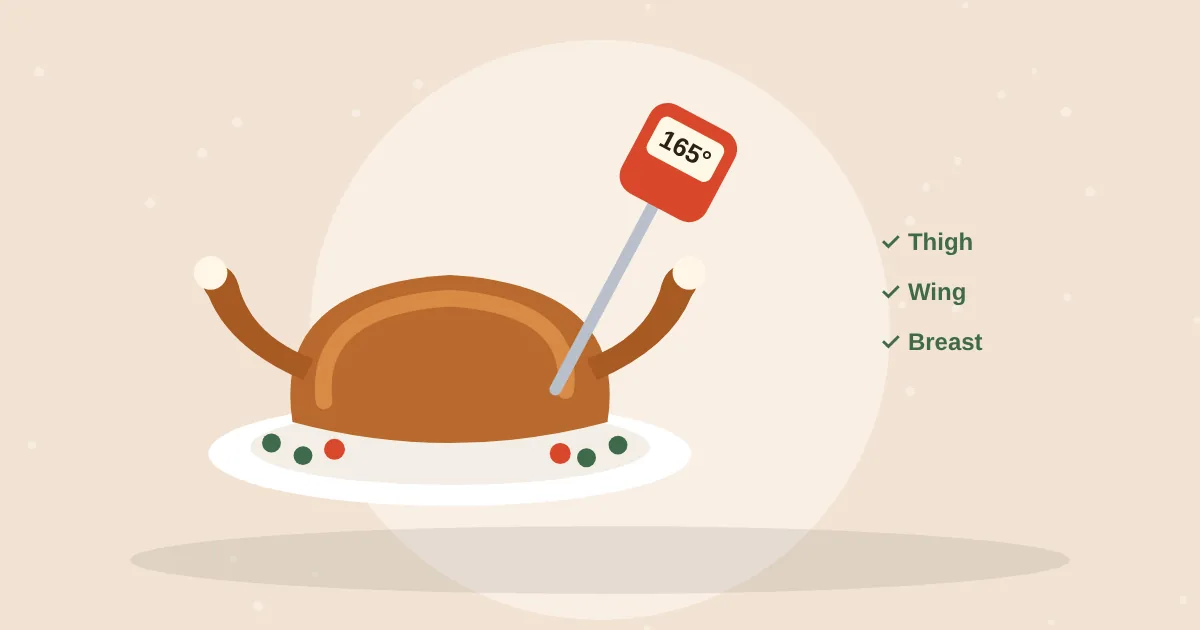
A turkey is done when a food thermometer reads at least 165°F (74°C) in three places: the innermost part of the thigh, the innermost part of the wing, and the thickest part of the breast. If the turkey is stuffed, the center of the stuffing must also reach 165°F. Let the turkey rest for 20–30 minutes before carving.
- Safe temp165°F (74°C)
- CheckThigh, wing & breast
- Stuffing165°F in the center
- Rest20–30 minutes
In this guide
Turkey Temperature Chart
| Part | Safe minimum | Notes |
|---|---|---|
| Breast (thickest part) | 165°F (74°C) | Dries out fastest – avoid going far beyond 165°F |
| Thigh (innermost part) | 165°F (74°C) | 175–180°F is more tender for dark meat |
| Wing (innermost part) | 165°F (74°C) | Check near the joint |
| Stuffing (center, inside the bird) | 165°F (74°C) | Check even if the meat is done |
| Ground turkey | 165°F (74°C) | Burgers, meatballs |
| Leftover turkey | 165°F (74°C) | When reheating |
The safe minimum temperature for all poultry is 165°F, according to FoodSafety.gov.
Where to Put the Thermometer in a Turkey
The USDA recommends checking three places, because different parts of the bird cook at different speeds:
- The innermost part of the thigh. Insert the probe into the thickest part of the thigh, near the body but not touching the bone. This is usually the last spot to get done.
- The innermost part of the wing. Insert it into the thick part of the wing near the joint.
- The thickest part of the breast. Insert it from the side, horizontally, so the tip sits in the center of the deepest part.
A leave-in probe thermometer placed in the thigh before roasting lets you watch the temperature without opening the oven. Confirm the breast and wing with an instant-read thermometer at the end.
Turkey Roasting Time Chart (325°F)
Use these times to plan your day, then use a thermometer to confirm doneness.
| Turkey weight | Unstuffed | Stuffed |
|---|---|---|
| 8–12 lb | 2¾ – 3 hours | 3 – 3½ hours |
| 12–14 lb | 3 – 3¾ hours | 3½ – 4 hours |
| 14–18 lb | 3¾ – 4¼ hours | 4 – 4¼ hours |
| 18–20 lb | 4¼ – 4½ hours | 4¼ – 4¾ hours |
| 20–24 lb | 4½ – 5 hours | 4¾ – 5¼ hours |
| Whole breast, 4–6 lb | 1½ – 2¼ hours | – |
Approximate times for a fully thawed turkey roasted at 325°F (163°C), from University of Illinois Extension and USDA timetables. Still frozen? Use our turkey thawing time calculator.
Why Pop-Up Timers and Clear Juices Aren't Enough
- Pop-up timers only measure one spot, usually in the breast. The thighs or stuffing may not be done when it pops – and some pop up after the breast is already overcooked.
- Clear juices aren't a reliable sign of safety. Turkey can run clear before it reaches 165°F, and pink juices or meat can appear in fully cooked birds, especially young or smoked turkeys.
- Wiggly legs show tenderness, not safety.
Only a food thermometer can tell you the turkey is safe.
Carryover Cooking and Resting
A large turkey keeps cooking after it leaves the oven – the internal temperature often rises another 5–10°F as it rests. That's one reason to rest the turkey for 20–30 minutes, loosely covered with foil, before carving. Resting also lets the juices settle back into the meat instead of running onto the board.
For food safety, make sure every spot you check has reached 165°F. To keep the breast from drying out, start checking temperatures about 30–45 minutes before the chart's shortest time.
Stuffing Safety
Stuffing cooked inside the bird absorbs raw turkey juices, so it must reach 165°F in its center – even if the meat is already done. If the meat is ready but the stuffing isn't, scoop the stuffing into a baking dish and finish it in the oven. For easier, safer timing, many cooks bake stuffing separately.
Common Mistakes to Avoid
- Checking only the breast. Fix: Check the thigh, wing and breast.
- Touching the bone with the probe. Fix: Pull back so the tip sits in the meat.
- Trusting the pop-up timer. Fix: Always confirm with a thermometer.
- Carving right away. Juices run out. Fix: Rest 20–30 minutes.
- Forgetting the stuffing. Fix: Check its center reaches 165°F.
- Roasting a partly frozen turkey without extra time. Fix: Thaw fully, or allow up to 50% more time.
The Bottom Line
Your turkey is done when the innermost part of the thigh, the innermost part of the wing and the thickest part of the breast all reach 165°F (74°C) – plus the center of any stuffing. Use the time chart to plan, a thermometer to confirm, and rest the bird for 20–30 minutes before carving. Then store the leftovers properly with our leftover turkey guide.
Frequently Asked Questions
What temperature is turkey done?
Turkey is done and safe to eat when it reaches 165°F (74°C) in the innermost part of the thigh, the innermost part of the wing and the thickest part of the breast.
Where do you put the thermometer in a turkey?
Insert it into the thickest part of the thigh near the body without touching the bone, then check the thick part of the wing and the thickest part of the breast.
Should turkey breast be 165 or 160?
For safety, the USDA recommends 165°F. Because turkey keeps cooking as it rests, some cooks remove it slightly earlier, but always make sure the meat reaches at least 165°F before serving.
Is it okay if turkey is a little pink?
Yes, if a thermometer shows 165°F in all three spots. Turkey can stay pink even when fully cooked, especially near the bones or in smoked turkey.
How long should a turkey rest before carving?
Rest a whole turkey for 20–30 minutes, loosely covered with foil. This lets the juices settle and makes carving easier.
Sources
- FoodSafety.gov – Safe Minimum Internal Temperatures
- University of Illinois Extension – Roasting an Unstuffed Turkey
Last reviewed November 6, 2026. Roasting times are estimates. Ovens and turkeys vary – always confirm doneness with a food thermometer.