Yes, radiologists can work from home. Radiology is one of the most remote-friendly medical specialties, because most of the work — reading CT, MRI and X-ray images and writing reports — can be done on a secure diagnostic workstation anywhere. This is called teleradiology. Remote radiologists still need a medical license in each state where their patients are, credentials at every hospital they read for, and a home setup with diagnostic-grade monitors and fast, secure internet.
In this guide
- How teleradiology works
- Types of remote radiology jobs
- What you need to work from home as a radiologist
- What about procedures and contrast supervision?
- How much do remote radiologists earn?
- Pros and cons of working from home as a radiologist
- Can a radiologist work remotely from another country?
- How to get a remote radiology job
- Frequently asked questions
How teleradiology works
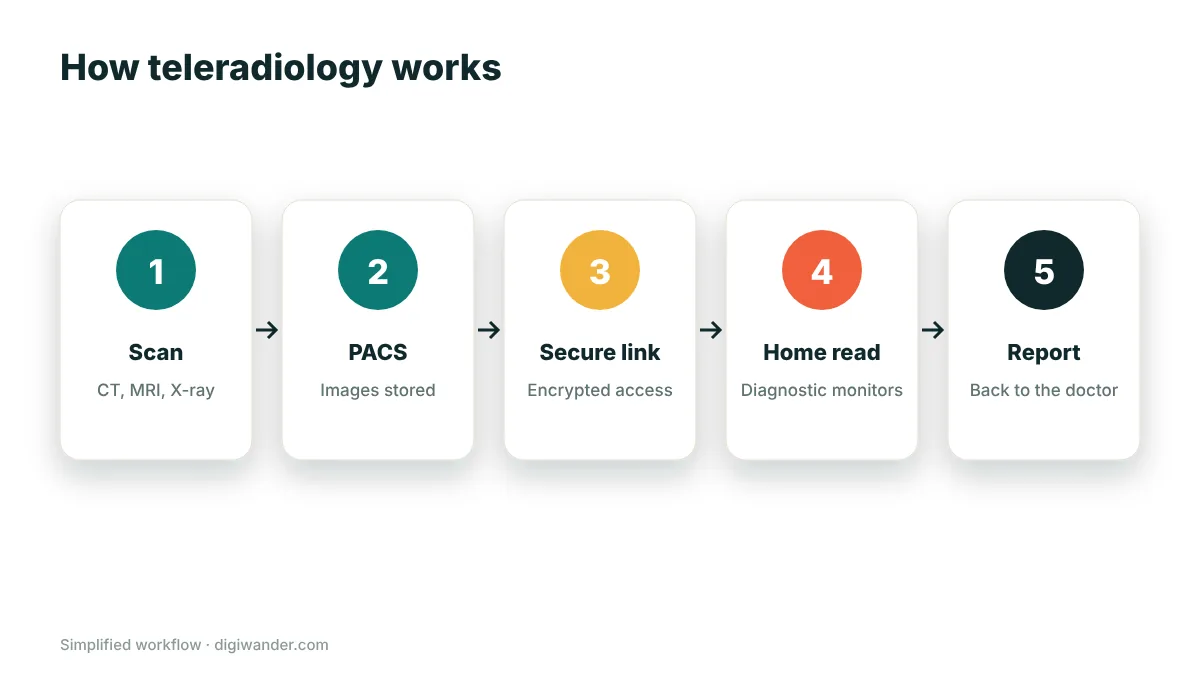
When a patient has a scan, the images are stored in the hospital’s PACS (picture archiving and communication system). A remote radiologist logs in securely, reviews the images on diagnostic monitors, dictates a report and sends it back to the ordering doctor — often within minutes for emergency cases. Teleradiology lets small and rural hospitals get round-the-clock and subspecialty reads they could not staff on site.
Types of remote radiology jobs
| Role | What it involves |
|---|---|
| Nighthawk / overnight coverage | Emergency reads for hospitals overnight and at weekends |
| Daytime teleradiology | Routine outpatient and inpatient reads for groups or companies |
| Subspecialty reads | Neuro, MSK, breast, pediatric or cardiac imaging for facilities without a subspecialist |
| Hybrid group roles | Some on-site days for procedures, the rest reading from home |
| Independent contractor (1099) | Per-study or per-shift work for one or more teleradiology companies |
What you need to work from home as a radiologist
- Full training: medical degree, radiology residency and usually board certification (fellowship training helps for subspecialty work).
- State medical licenses in every state where the patients are. The Interstate Medical Licensure Compact can speed up getting licenses in participating states.
- Hospital credentialing and privileges at each facility you read for — often handled with help from your teleradiology employer.
- A diagnostic workstation: calibrated, high-resolution diagnostic monitors, a powerful computer and dictation software.
- Fast, reliable, secure internet plus a backup connection — large imaging studies need serious bandwidth. See how much internet speed working from home needs.
- HIPAA-compliant security: private workspace, encrypted connections and strict access controls.
What about procedures and contrast supervision?
Interventional procedures and some exams still need a radiologist on site. But rules on supervision have loosened: in its 2026 outpatient final rule, CMS made virtual direct supervision of Level 2 diagnostic tests — such as CT and MRI with contrast — permanent from January 1, 2026 for Medicare hospital outpatients, as long as the supervisor uses real-time audio and video and state law allows it. That makes more hybrid and remote schedules possible.
How much do remote radiologists earn?
Radiology is among the highest-paid medical specialties. Salary data cited by teleradiology providers puts typical remote radiologist pay at around $300,000–$400,000 a year, with wide variation by subspecialty, workload and contract type. Many teleradiology jobs pay per study or per RVU, so faster readers can earn more — and overnight shifts often pay a premium. Compare pay in other remote careers in our guide on how much you can earn working remotely.
Pros and cons of working from home as a radiologist
Pros
- No commute and more control over your schedule
- Live where you want (within licensing rules)
- Quiet environment for focused reading
- Exposure to cases from many facilities
Cons
- Professional isolation and less teaching
- Cost and paperwork of multiple licenses
- Equipment and IT responsibility
- Overnight and high-volume shifts can cause burnout
Can a radiologist work remotely from another country?
It is possible but complicated. Reading US studies from abroad raises issues of licensing, data security, malpractice insurance and payer rules, and many employers require you to be physically in the US. Some groups offer overnight coverage from countries in other time zones under specific arrangements. Always confirm with your employer and legal adviser before planning to read from abroad. If you are considering it, our Portugal D8 visa guide shows what nomad visas typically require.
How to get a remote radiology job
- Finish training and get board certified.
- Get licensed in several states, using the Interstate Medical Licensure Compact where available.
- Build speed and accuracy in high-demand areas such as emergency and neuro imaging.
- Apply to teleradiology companies and groups — specialty job boards list many fully remote roles; see also the best websites to find remote work.
- Set up your home workstation to your employer’s specifications.
Frequently asked questions
Can radiologists work from home full time?
Yes. Many teleradiology jobs are 100% remote, especially overnight emergency coverage and routine reads. Procedures and some exams still require on-site work.
What do radiologists need to work from home?
A medical license in each state where patients are located, credentials at each hospital, diagnostic-grade monitors, a powerful workstation, secure fast internet and HIPAA-compliant security.
How much do remote radiologists make?
Salary data cited by teleradiology providers puts typical remote radiologist pay around $300,000–$400,000 a year, varying by subspecialty, workload and contract type.
Can radiologists supervise contrast exams remotely?
From January 1, 2026, CMS allows virtual direct supervision of Level 2 diagnostic tests such as CT and MRI with contrast for Medicare hospital outpatients, using real-time audio and video, where state law permits.
Can a radiologist work remotely from another country?
It is possible in limited cases but complicated by licensing, data security, malpractice and payer rules. Many employers require radiologists reading US studies to be in the US.
Sources
- Reed Smith — CMS makes virtual direct supervision permanent
- Interstate Medical Licensure Compact
- Candelis — Can radiologists work from home?
Last updated . Fees, rules and prices change often — confirm current details with the official source before you act. This article is for information only and is not financial advice. See our disclaimer.